Is “Not Your Keys, Not Your Coins” Still Enough?
A recent market analysis shared in our Aurum community brought up one of the most important questions in digital assets right now:
Who really controls your crypto?
For years, the common phrase in crypto has been:
“Not your keys, not your coins.”
The idea was simple. If you hold your own private keys, you control your assets. If your crypto sits on an exchange or inside a platform where someone else controls access, you are depending on that third party.
That idea still matters.
But the digital asset world has changed.
Today, control is not only about who holds the private key. It is also about what infrastructure your assets interact with, what smart contracts are involved, what risks exist at the protocol level, and whether there are centralized chokepoints that can freeze, block, or interrupt access.
That is why this topic is becoming much bigger than a simple wallet phrase.
The Problem With “Ownership” in Crypto
A lot of people believe that once they move assets into a self-custody wallet, the risk is mostly solved.
But recent market events have shown that crypto ownership can still become complicated.
There are several major risk areas that users need to understand:
Exchange risk — when assets are held on centralized exchanges, users may not have full control if withdrawals are paused, accounts are frozen, or the exchange runs into trouble.
Token freeze risk — some tokens, especially stablecoins and certain contract-based assets, may include mechanisms that allow freezing or blacklisting under specific conditions.
Smart contract risk — even if you control your wallet, your assets may still interact with smart contracts that can contain bugs, vulnerabilities, admin controls, or design weaknesses.
Network and infrastructure risk — bridges, decentralized applications, protocols, and third-party tools can create additional exposure beyond just holding a wallet.
That means the real question is no longer simply:
“Do I hold my keys?”
The better question is:
“What systems are my assets depending on?”
Why Smart Contracts Matter
Smart contracts are one of the biggest innovations in digital assets.
They can automate trading, manage decentralized applications, execute transactions, and allow users to interact without relying on a traditional centralized company to manually control every step.
But smart contracts also need to be designed carefully.
If the code has weaknesses, users can be exposed. If the system depends too heavily on centralized admin controls, users may not have as much independence as they think. If the protocol has not been reviewed properly, risks may be hidden until something goes wrong.
That is why security audits, bug bounty programs, and ongoing infrastructure testing are becoming more important.
A one-time audit is helpful, but the industry is moving toward continuous validation. The stronger platforms are not just asking, “Did the code pass once?” They are asking, “How do we keep testing, reviewing, and improving the system over time?”
Where Neyro Fits Into This Conversation
This is where Neyro becomes interesting.
Neyro has been part of the broader discussion around user-controlled assets, smart contracts, and non-custodial infrastructure.
The key idea is simple:
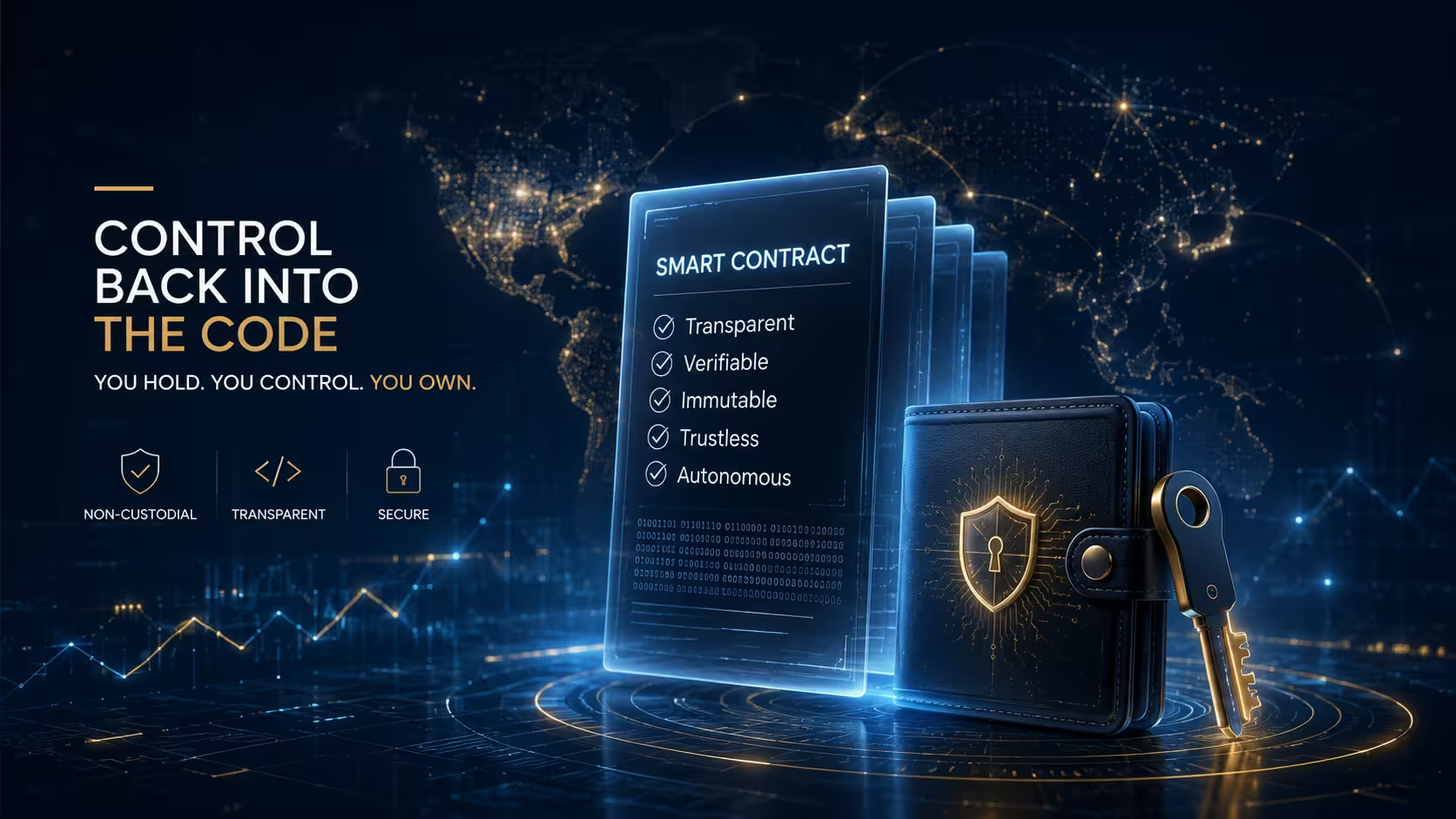
Instead of forcing users to hand over control of their funds to a centralized trading platform, the future may move toward smart contract-based systems where users maintain more control while automated tools execute based on transparent code and defined rules.
That does not remove all risk.
Digital assets always carry risk. Smart contracts carry risk. AI-powered trading tools carry risk. No platform can guarantee future results.
But there is a major difference between a system where users simply deposit funds into a black box and a system designed around more transparent, contract-based execution.
That is why the conversation around non-custodial trading is growing.
Security Is Becoming the Real Alpha
A lot of people look at crypto only through the lens of profit.
They ask:
“How much can it make?”
“How fast can it grow?”
“What is the return?”
Those questions are understandable, but they are incomplete.
The more important question is:
“How is the system built?”
Because in digital assets, security is not optional.
Security affects trust.
Trust affects adoption.
Adoption affects long-term growth.
This is why audits, bug bounty testing, ethical hacker review, smart contract design, and infrastructure resilience matter so much.
When users are dealing with AI-powered trading, decentralized finance, or digital asset platforms, they need more than flashy numbers. They need to understand the structure behind the system.
Why This Matters for Aurum
Aurum is operating in one of the fastest-moving areas of financial technology: AI-powered finance, digital assets, real-world asset strategies, and non-custodial trading infrastructure.
That is exciting, but it also means risk awareness matters.
The goal is not to ignore risk.
The goal is to understand it better.
Aurum and Neyro are part of a bigger shift toward financial tools that combine automation, smart contracts, and user-controlled infrastructure. That is a very different conversation than traditional centralized platforms where users simply deposit assets and hope the company manages everything correctly.
This is why we continue watching the security side closely.
Performance gets attention.
But infrastructure is what matters long term.
The Bigger Picture
The digital asset industry is maturing.
The old mindset was:
“Just hold your keys.”
The new mindset is becoming:
“Understand the entire system your assets depend on.”
That includes wallets, networks, smart contracts, stablecoins, protocols, audits, security testing, and platform design.
This is not about fear.
It is about education.
If you are going to participate in digital assets, AI trading tools, or passive crypto income opportunities, you need to understand both the potential and the risks.
That is exactly why we created Stop Chasing Now.
We help people slow down, understand what they are looking at, ask better questions, and avoid jumping into something blindly.
Final Thought
“Not your keys, not your coins” is still an important principle.
But it is no longer the whole conversation.
In today’s digital asset world, the better question is:
Who really controls your assets — and what systems are they connected to?
That is why non-custodial infrastructure, smart contract transparency, and ongoing security validation are becoming so important.
And it is why we believe Aurum and Neyro are worth paying attention to.
When you join through us, you get more than just access to the platform. You get onboarding help, setup guidance, our marketing funnel, AI follow-up tools, live chat/voice support, and a team to help you avoid common mistakes.
Start with the overview, review the setup guide, and make your own informed decision.