Aurum Regulatory Status Update: What the Swiss SRO Move Means
The latest Aurum regulatory status update focuses on a subject that is becoming more important across digital finance: building the legal and compliance infrastructure needed to support long-term growth.
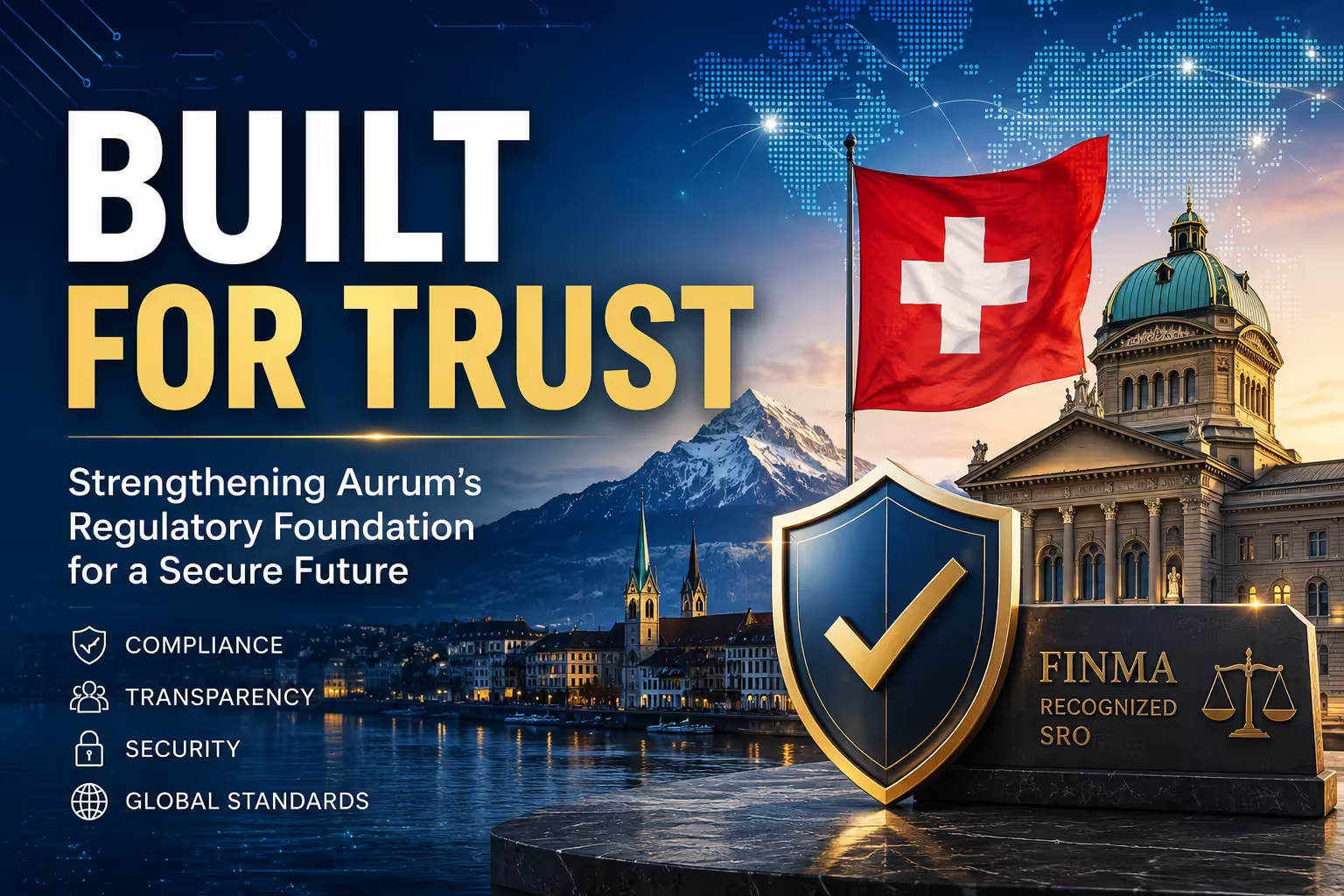
In the video update, Aurum leadership says Neviro has completed the acquisition of a Swiss financial intermediary associated with a self-regulatory organization, or SRO, recognized by Switzerland’s financial-market regulator, FINMA. The company says integration work is now underway.
This could be a meaningful step in Aurum’s broader strategy. It also needs to be understood accurately. An SRO relationship supports specific compliance responsibilities, especially around anti-money-laundering rules, but it is not the same as becoming a bank or receiving blanket approval for every product in every country.
Why the Aurum regulatory status update matters
Regulation is sometimes presented as an obstacle in the crypto and digital-asset industry. For a company trying to build products across multiple jurisdictions, however, compliance infrastructure can also be part of what makes responsible expansion possible.
Financial technology does not operate in a legal vacuum. Rules may change depending on the product, the customer’s location, who controls the assets, how transactions are processed, and which company entity provides the service.
Aurum’s presentation describes regulation as part of its long-term development strategy rather than something to address after the platform grows. That is the central idea behind this update.
What Aurum says it acquired
According to the presentation, Neviro acquired a Swiss financial intermediary that is connected to a FINMA-recognized SRO. Aurum says the entity may allow relevant parts of the business to operate through a Swiss compliance structure when that structure is appropriate.
The announcement highlighted several possible functions:
- Digital-asset services
- Cryptocurrency and foreign-exchange operations
- Anti-money-laundering compliance
- Know Your Customer and Know Your Business procedures
- Over-the-counter services
- Transaction monitoring
These are important capabilities for a financial ecosystem, but the exact legal scope depends on the entity, its SRO membership, the products involved, and the jurisdictions where those products are offered.
What FINMA is
FINMA is Switzerland’s independent financial-markets regulator. Its mandate includes supervising banks, insurance companies, financial institutions, collective investment schemes, and other regulated participants in the Swiss financial system.
FINMA also recognizes and supervises self-regulatory organizations that operate within Switzerland’s anti-money-laundering framework.
What a Swiss SRO does
SRO stands for self-regulatory organization.
Under the Swiss system, certain financial intermediaries become members of an SRO operating under civil law. The SRO monitors those members for compliance with applicable anti-money-laundering obligations, while FINMA recognizes and supervises the SRO itself.
You can review FINMA’s explanation of self-regulatory organizations and their role directly on the regulator’s website.
In practical terms, the compliance structure may involve responsibilities such as:
- Verifying customer identities
- Identifying beneficial owners
- Evaluating higher-risk relationships
- Monitoring transactions
- Maintaining compliance records
- Investigating suspicious activity
- Meeting reporting requirements when applicable
These controls are intended to make it more difficult for financial services to be used for money laundering, terrorist financing, sanctions evasion, fraud, or other prohibited activity.
Why the distinction between SRO membership and a FINMA license matters
This is one of the most important parts of the update.
A financial intermediary affiliated with a recognized SRO participates in a legitimate Swiss regulatory framework. That does not necessarily mean the intermediary is directly licensed by FINMA as a bank, securities firm, or another prudentially supervised institution.
FINMA explains that recognized SROs are supervised for compliance with money-laundering rules, while their members are monitored by the SRO. FINMA also notes that SROs are not prudentially supervised in the same way as banks and certain other financial institutions. You can read more about the supervision of Swiss SROs.
That does not make the development unimportant. It simply means the announcement should be described precisely.
How the new structure could support digital-asset services
Custodial and non-custodial products
The video discusses the difference between custodial and non-custodial services.
With a custodial service, a company or institution holds or controls assets on behalf of the customer. With a non-custodial service, the customer generally retains control through a personal wallet or similar arrangement.
Custody can create additional responsibilities involving safeguarding, recordkeeping, customer protection, security, and compliance. The legal requirements can vary significantly by service and location.
Aurum says the Swiss entity could help provide a regulatory path for products that require this type of infrastructure, while other parts of the ecosystem may continue to use non-custodial or decentralized structures.
Cryptocurrency and foreign-exchange operations
The presentation also identifies cryptocurrency and foreign-exchange operations as priorities.
The ability to build a product technically is not the same as having permission to offer it everywhere. A company may need different registrations, authorizations, policies, or entities depending on what the service does and where the customer is located.
The Swiss intermediary appears intended to become one part of that broader legal and operational framework.
KYC and KYB procedures
KYC means Know Your Customer. KYB means Know Your Business.
These procedures help financial providers establish who is using a service and, for a business, who ultimately owns or controls it. Depending on the risk and jurisdiction, this may involve identity documents, facial verification, address checks, corporate records, and beneficial-owner information.
These steps can create friction for users, but they are also a standard part of responsible financial compliance.
Transaction monitoring
Blockchain transactions can sometimes be traced to wallets associated with theft, scams, sanctions, illicit marketplaces, or other suspicious activity.
Transaction-monitoring tools can evaluate wallet history, counterparties, patterns, and other risk indicators before or after a transfer. That can help a platform identify transactions requiring additional review.
It does not mean every unusual transaction is illegal. It means the platform may have better tools for understanding where funds originated and whether additional action is required.
How MiCA fits into the conversation
The presentation also refers to Europe’s Markets in Crypto-Assets Regulation, commonly called MiCA.
MiCA created a harmonized European Union framework for crypto-assets and related services not already covered by other financial-services laws. The framework addresses areas including crypto-asset issuers, service providers, consumer protection, market integrity, and operational requirements.
The European Commission’s crypto-assets overview provides more information about the regulation and its purpose.
A Swiss SRO-affiliated intermediary may strengthen Aurum’s overall compliance foundation, but Switzerland is not part of the European Union. The acquisition should therefore not be interpreted automatically as complete MiCA authorization or permission to provide every service throughout Europe.
The answer depends on the service, the legal entity providing it, the customer’s location, and the authorization required under the applicable rules.
What this announcement does not mean
The Aurum regulatory status update should not be interpreted as proof that:
- Every Aurum product is approved in every country
- All integration work has been completed
- The acquired entity is a bank
- SRO membership equals a blanket FINMA license
- Every service carries the same regulatory status
- Compliance eliminates investment, technology, custody, or market risk
- Regulation guarantees performance or protects users from every possible loss
The most accurate reading is that Aurum has announced another component of the compliance infrastructure it believes it needs to develop its planned financial ecosystem.
Questions members should continue asking
It is reasonable to view the update as encouraging. It is equally reasonable to continue doing due diligence.
Useful questions include:
- What is the legal name of the acquired entity?
- Which recognized SRO supervises it?
- Can its membership be confirmed through FINMA’s public search tools?
- Which Aurum products will operate through that entity?
- Which countries will those services support?
- Will each service be custodial or non-custodial?
- What customer protections apply?
- What information will be collected through KYC, KYB, and transaction monitoring?
- Which parts of the integration are live, and which remain under development?
FINMA provides an online SRO member search that can help the public verify financial intermediaries listed as members of recognized organizations.
Why this could be an important long-term step
The most important part of this announcement may not be a single acronym or regulatory label.
It is the broader recognition that building an AI-powered financial ecosystem requires more than software.
It requires legal entities, compliance programs, customer-verification systems, transaction monitoring, risk controls, data protection, operational procedures, and a clear understanding of which rules apply in each market.
Those systems rarely attract the same attention as a new product. They are often what determine whether a product has a foundation capable of supporting responsible growth.
The real test will be how Aurum integrates the entity, which services it ultimately supports, and how transparently the company communicates its status as the ecosystem develops.
The Stop Chasing Now perspective
At Stop Chasing Now, we believe education should come before action.
Our role is not to tell anyone to trust a headline or make a financial decision based on one announcement. Our role is to help people understand what is being presented, identify the questions that still need answers, and approach modern financial technology with greater confidence.
Regulatory progress can be meaningful without being exaggerated.
Good questions do not weaken trust. They help informed trust develop.
Frequently asked questions
Is Aurum now licensed by FINMA?
The video says Neviro acquired a Swiss financial intermediary associated with a FINMA-recognized SRO. That is not necessarily the same as Aurum itself receiving a direct FINMA banking or financial-institution license. The exact status should be evaluated using the legal name of the entity and the applicable public records.
Does the SRO acquisition mean Aurum can operate everywhere in Europe?
No. A Swiss SRO relationship does not automatically provide blanket authorization throughout the European Union. Product availability depends on the service, entity, jurisdiction, and relevant rules, including MiCA where applicable.
Why are AML, KYC, and transaction monitoring important?
They help financial providers identify customers, understand higher-risk activity, and reduce the misuse of services for money laundering, fraud, sanctions evasion, and other prohibited conduct.
Does stronger compliance make Aurum risk-free?
No. Compliance infrastructure can help a company operate more responsibly, but it cannot eliminate digital-asset, trading, technology, counterparty, legal, operational, or market risk.
The bottom line
The latest Aurum regulatory status update describes a company working to strengthen the infrastructure behind its digital-asset and AI-finance plans.
According to Aurum leadership, the acquisition of a Swiss financial intermediary connected to a FINMA-recognized SRO is intended to support areas such as AML compliance, customer verification, transaction monitoring, digital-asset services, and future international operations.
That may represent meaningful progress. It is not a blanket approval, a guarantee of future access, or a promise of financial results.
The responsible response is to understand the announcement, follow the integration, verify the status of individual entities and products, and continue asking clear questions.
Need help understanding Aurum?
Stop Chasing Now provides education, onboarding guidance, and one-on-one support for people who want to understand Aurum, digital assets, wallets, platform setup, and the risks involved before deciding what to do next.
Schedule a one-on-one Aurum walkthrough
Important disclosure: This article summarizes statements made in Aurum’s regulatory status video. It should not be treated as independent confirmation that every license, authorization, integration, or service described is active in every jurisdiction. Regulatory status and product availability may change.
This content is provided for education and general information only. It is not financial, investment, tax, or legal advice. Digital assets and AI-powered financial tools involve risk, including the possible loss of funds. Conduct your own research and never use money you cannot afford to risk.