Why True Digital Asset Maturity Demands Non-Custodial AI: Andrew Isaacs on Neyro, Security and the Future of Finance
Artificial intelligence is rapidly changing how people research markets, build businesses and manage information.
But one of the most important questions is only beginning to receive serious attention:
What happens when AI can do more than analyze financial markets—and begins acting inside them?
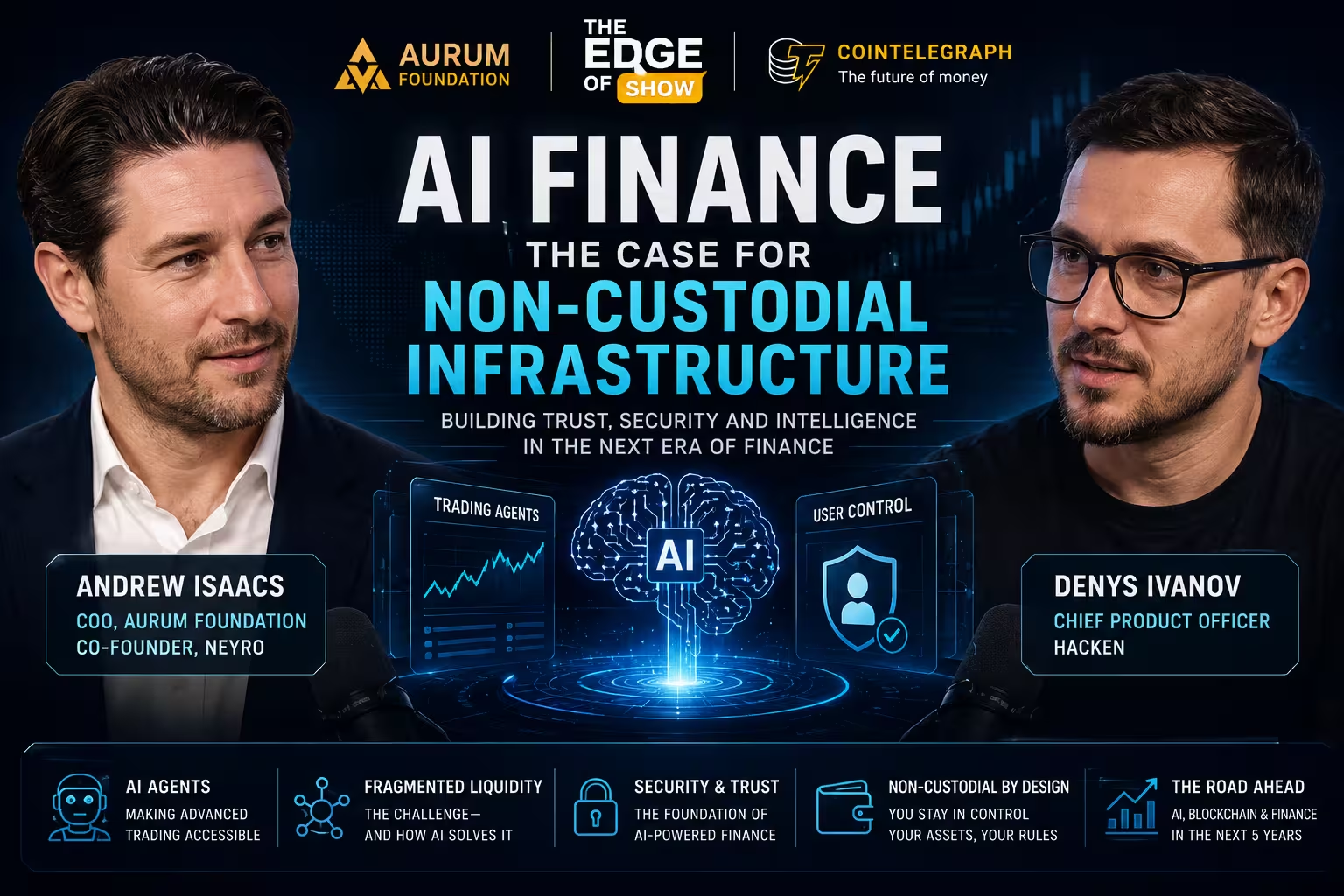
That question sits at the center of a special episode of The Edge of Show, produced in partnership with Cointelegraph.
The conversation featured Andrew Isaacs, Chief Operating Officer of AURUM Foundation and Co-Founder of Neyro, alongside Denys Ivanov, Chief Product Officer at blockchain security company Hacken.
The episode has reportedly attracted more than 236,000 views, reflecting growing interest in AI-powered trading agents, decentralized financial infrastructure and the security challenges that emerge when intelligent software is allowed to interact with real money.
The discussion was not simply about building another trading bot.
It explored a much larger idea:
Can AI give ordinary users access to sophisticated financial tools while allowing them to remain in control of their own assets?
That distinction—between AI that helps manage assets and a platform that takes custody of them—may become one of the defining issues in the next stage of digital finance.
Digital Assets Are Moving Beyond the Speculation Phase
Isaacs opened by explaining why he came to view digital assets as more than another temporary technology cycle.
According to the show’s introduction, his background includes nearly two decades across investment banking and digital assets, including positions connected with Morgan Stanley, Evercore and Galaxy Digital. The host also credited him with advising on more than $23 billion in transactions across traditional and emerging markets.
From that perspective, Isaacs identified several developments that convinced him the industry was maturing.
The first was the shift from projects built mainly on hype toward blockchain businesses with measurable activity.
During the initial coin offering boom, many projects attracted capital based on a white paper, a founding team and ambitious promises.
Today, serious participants increasingly look for evidence such as:
- On-chain revenue
- Total value locked
- Sustainable user activity
- Transparent vesting schedules
- Functional products
- Repeatable business models
In other words, the market is gradually asking harder questions.
Not simply:
Who is behind the project?
But also:
Does the product work, do people use it and can the economics survive?
That is a healthier standard for the industry.
Stablecoins Changed the Conversation
Isaacs also pointed to the growing use of stablecoins, especially USDT, for remittances and international payments.
That development matters because stablecoins demonstrate practical utility beyond speculation.
A person sending money across borders may care less about cryptocurrency ideology and more about whether the transaction is:
- Faster
- Less expensive
- Available outside banking hours
- Easier to access
- Less dependent on multiple intermediaries
Stablecoins have shown that blockchain networks can function as financial infrastructure.
They also present a challenge to traditional banking models.
When users can hold dollar-linked digital assets, transfer them continuously and potentially access yield-bearing products, the conventional bank savings model begins facing a new form of competition.
Traditional finance is therefore no longer observing digital assets from a distance.
It is increasingly being forced to respond.
The Two Problems Neyro Is Trying to Solve
When asked about the problem behind Neyro, Isaacs focused on two major weaknesses in digital asset markets:
Fragmented liquidity and overwhelming data density.
These may sound technical, but they affect nearly every active participant in decentralized finance.
Fragmented Liquidity Explained Simply
Imagine trying to purchase a large quantity of the same product, but instead of one organized marketplace, the inventory is spread across dozens of small stores.
Each store has a different price.
Some have limited stock.
Some are located in different countries.
Some require a special bridge or transportation system to reach them.
The best deal might change before you arrive.
That is similar to fragmented liquidity in digital asset markets.
Different blockchains contain different liquidity pools. Assets may be traded through multiple decentralized exchanges, protocols and bridges.
A user attempting to execute a strategy may need to determine:
- Where the liquidity currently exists
- Which blockchain offers the best opportunity
- What bridge is required
- What fees apply
- Whether the price will move during execution
- Whether the smart contracts involved are trustworthy
- Whether another opportunity is better elsewhere
An experienced trader may be able to navigate some of this manually.
But the market operates 24 hours a day, and conditions can change within seconds.
That is where AI agents may provide an advantage.
An agent can continuously scan markets, compare opportunities and respond to changing conditions without becoming tired or distracted.
The Problem of Data Overload
Blockchain markets create enormous amounts of information.
Transactions, wallet movements, liquidity changes, contract activity and market prices can often be observed publicly.
Transparency is one of blockchain’s strengths.
But transparency also creates another problem:
There may be too much data for a human to process effectively.
Isaacs compared the experience to a human version of a distributed denial-of-service attack.
A trader may technically have access to the information but still be unable to analyze it quickly enough.
An AI agent can potentially examine far more data points than a person, connect patterns and narrow the information into something useful.
That does not mean the agent will always reach the correct conclusion.
It means the agent may help solve the first problem every trader faces:
Knowing what deserves attention.
What Is Agentic Trading?
The phrase “agentic trading” is becoming more common, but it is often used without a clear explanation.
Isaacs described it through a simple analogy.
Imagine hiring a professional to help execute your trading strategy.
You tell that person:
- Which assets they may consider
- Which assets are off limits
- When they may buy or sell
- How much risk is acceptable
- What loss limits must be respected
- What type of strategy you want followed
The person performs the research and manual work, but you remain responsible for the overall direction.
An AI trading agent attempts to provide a similar service through software.
The user defines the strategy and boundaries.
The agent monitors data, searches for opportunities and executes within the permitted framework.
Unlike a human, the agent does not need to sleep. It can monitor markets continuously and process far more information.
But this analogy also reveals an important truth:
The quality of the result still depends on the instructions, data, security and risk controls surrounding the agent.
An AI agent is not magic.
It is not a guaranteed-profit machine.
It is a tool operating inside a defined system.
The Goal: Give Ordinary Users Tools Previously Reserved for Professionals
Sophisticated trading firms have used quantitative systems, automation and machine learning for decades.
The concept of machines assisting with trading is not new.
What is changing is accessibility.
Advanced systems were historically expensive to build and maintain. They required specialized developers, traders, infrastructure and large amounts of data.
Most individuals could not justify the cost.
Isaacs described Neyro’s longer-term mission as giving average users access to tools that were previously available mainly to professional traders, quantitative firms and larger financial institutions.
That could allow a person with a market view to create a more advanced strategy without personally monitoring every movement.
For example, a user might believe Bitcoin could decline over the coming weeks but still experience a temporary rally.
A simple trader may only know how to place a buy or sell order.
A more sophisticated strategy might involve:
- Multiple entry points
- Hedging
- Options
- Stop-loss limits
- Position sizing
- Automated profit-taking
- Different responses under different market conditions
An AI agent may eventually make that type of strategy easier to construct and manage.
The user would still be responsible for deciding what risks to take.
The agent would help with the execution.
Why Non-Custodial Infrastructure Matters
The most important aspect of this model may not be the artificial intelligence.
It may be the custody structure.
In a custodial platform, users transfer their assets to a company or fund. The platform then controls the assets on the user’s behalf.
That structure requires trust.
The user must trust that the company:
- Holds the assets securely
- Does not misuse them
- Remains solvent
- Processes withdrawals
- Follows its stated strategy
- Protects private information
- Complies with applicable regulations
A non-custodial system works differently.
The user keeps assets connected to their own wallet, while authorized smart contracts or agents execute specific actions within defined permissions.
A simple analogy is hiring a driver without giving that person ownership of your car.
The driver may be permitted to operate it under certain conditions.
But the vehicle still belongs to you.
In theory, this structure can reduce certain forms of counterparty risk because users do not have to hand complete control of their assets to a centralized fund.
However, non-custodial does not mean risk-free.
A poorly designed smart contract can still be exploited.
Permissions can be too broad.
Wallets can be compromised.
An agent can make a bad decision.
A malicious transaction can be signed.
The system may reduce one category of risk while introducing another.
That is why the security discussion in the podcast was so important.
The Security Expert Became More Concerned as the Conversation Continued
As Isaacs explained what AI trading agents could potentially do, Hacken’s Denys Ivanov acknowledged the enormous opportunity.
He also said the discussion made him increasingly concerned.
That reaction should not be dismissed as negativity.
It is the response of someone thinking about what happens when an intelligent system is connected to financial infrastructure.
An AI agent that can analyze markets and execute transactions is powerful.
But anything with that power will attract attackers.
Ivanov highlighted several areas that require attention from the beginning:
- Red-team testing
- Prompt-injection defenses
- Smart-contract security
- Infrastructure monitoring
- Access controls
- Anomaly detection
- Incident-response systems
- Continuous risk assessment
The message was clear:
Security cannot be added after the financial agent has already been built.
It must be part of the architecture.
Why Prompt Injection Is a Financial Risk
Most people associate prompt injection with chatbots producing an incorrect or inappropriate answer.
The risk becomes far more serious when an AI system can interact with assets.
A prompt injection occurs when malicious instructions are hidden inside information the AI is asked to process.
Those instructions may appear in:
- Text
- Websites
- Code
- Images
- Documents
- Smart-contract repositories
- Data feeds
- External tools
The AI may interpret the malicious content as an instruction rather than untrusted information.
In a financial system, that could potentially influence how an agent evaluates or executes a transaction.
Consider an AI agent that scans websites, market information and code repositories.
A malicious actor could attempt to place hidden instructions inside one of those sources.
If the system is not properly isolated and protected, the agent might be manipulated into:
- Ignoring a risk warning
- Favoring a specific asset
- Visiting a malicious contract
- Revealing confidential information
- Changing a trading parameter
- Approving an unintended action
This does not mean every AI agent is vulnerable in exactly the same way.
It means developers must assume manipulation attempts will occur.
AI Finance Requires More Than a Good Trading Strategy
A trading strategy may perform well during normal conditions.
That is not enough.
A serious AI-finance platform must also survive abnormal conditions.
What happens when:
- Liquidity disappears?
- A blockchain stops producing blocks?
- A bridge is exploited?
- A stablecoin loses its peg?
- A price feed fails?
- Gas fees spike?
- A wallet connection is compromised?
- An agent receives conflicting instructions?
- Market volatility exceeds historical patterns?
- A smart contract behaves unexpectedly?
Risk management must answer those questions before users commit significant capital.
This is one reason Ivanov emphasized continuous monitoring.
A one-time audit is valuable, but financial infrastructure changes.
New code is deployed.
Dependencies are updated.
Threats evolve.
Attackers discover new techniques.
Security therefore needs to be treated as an ongoing process rather than a certificate obtained once and placed on a website.
Trust Must Be Demonstrated
Isaacs repeatedly returned to the importance of trust.
In digital assets, companies often tell users to trust the platform.
But trust cannot be created through marketing alone.
It must be supported by evidence.
That evidence may include:
- Transparent leadership
- Public documentation
- Independent audits
- Clear smart-contract permissions
- Security monitoring
- Real product usage
- Verifiable performance data
- Honest risk disclosures
- Responsible economics
- Regulatory compliance where required
Isaacs identified three factors that emerging technology companies must align:
Trust, economics and product-market fit.
A company can have brilliant technology but fail because users do not trust it.
It can have trusted leadership but fail because the economics are unsustainable.
It can be well funded but fail because people do not actually want the product.
Long-term success requires all three.
Transparency Is Especially Important for AI Trading
AI can easily become a marketing term.
A company may claim its system uses advanced artificial intelligence without clearly explaining:
- What the agent actually does
- What data it uses
- Which decisions are automated
- What requires human approval
- How risk limits are enforced
- Whether users retain custody
- How the company earns revenue
- What happens during losses
- What performance has been independently verified
The podcast included an important moment of transparency.
When asked whether Neyro had hard metrics proving superiority over competing approaches, Isaacs said he did not yet have public metrics to provide during the discussion.
He explained that the platform had only recently come out of beta.
That is worth emphasizing.
Promising technology should be evaluated on real results as they become available.
Early confidence is not the same as independently verified performance.
The responsible position is to recognize the potential while waiting for more evidence.
AI Agents May Change the Role of the User
The future of AI finance is not necessarily one in which machines replace people entirely.
A more realistic model may involve changing what the person is responsible for.
Instead of manually watching charts, the user may focus on:
- Defining objectives
- Setting risk limits
- Selecting permitted assets
- Reviewing strategy recommendations
- Approving major changes
- Monitoring performance
- Deciding when to increase or reduce exposure
The agent handles repetitive analysis and execution.
The user remains responsible for judgment and risk.
This division could make advanced financial tools more accessible without removing human control completely.
It may also reduce some emotional mistakes.
Human traders can become impatient, fearful, overconfident or exhausted.
An agent can follow rules consistently.
But an agent can also consistently follow a bad rule.
Discipline is valuable only when the strategy itself is sound.
What Happens When Every Trader Has an AI Agent?
The podcast also raised an interesting market question.
If everyone gains access to intelligent trading agents, do the opportunities disappear?
Consider a navigation app.
If the app tells every driver to take the same alternative route, that route may quickly become congested.
The same principle can apply to financial markets.
If many agents identify the same opportunity, they may all attempt to execute it.
The price changes.
The opportunity shrinks.
Eventually, the agents may effectively trade against one another.
Isaacs acknowledged that diminishing returns could occur, especially where liquidity is limited.
The most effective systems may therefore be those with:
- Better data
- Greater liquidity access
- More sophisticated models
- Faster adaptation
- Stronger risk controls
- More diverse strategies
AI may make some opportunities easier to discover.
It may also cause those opportunities to disappear more quickly.
The Next Five Years of AI, Blockchain and Traditional Finance
When asked what finance could look like five years from now, Isaacs avoided pretending he had a perfect prediction.
That honesty is appropriate.
Artificial intelligence, blockchain and traditional finance are evolving too quickly for anyone to know exactly how they will converge.
Still, several directions appear possible.
Traditional financial institutions may use blockchain systems as transparent testing environments.
AI agents may assist with decentralized governance.
Automated organizations may manage certain financial processes with limited human involvement.
Digital assets may become collateral inside traditional products.
Non-custodial agents may execute increasingly complex strategies.
Stablecoins may serve as settlement tools between people, companies and autonomous software.
Traditional finance and decentralized finance may gradually borrow the strongest features from one another.
Traditional finance brings experience in:
- Compliance
- Risk management
- Customer protection
- Institutional controls
- Governance
Blockchain brings:
- Transparency
- Programmability
- Continuous settlement
- Global accessibility
- Verifiable transactions
- User-controlled assets
AI may become the layer that helps users navigate both.
What This Conversation Reveals About AURUM Foundation
This episode is particularly relevant for people following AURUM Foundation because Andrew Isaacs’s role connects the discussion to Aurum’s broader AI-finance direction.
The conversation helps clarify that the vision is not simply about attaching the term “AI” to a trading product.
The larger opportunity involves building an ecosystem around:
- Intelligent financial agents
- Non-custodial infrastructure
- User-controlled assets
- Blockchain transparency
- Stablecoin utility
- Risk management
- Security monitoring
- Accessible financial tools
That is a much more ambitious goal than creating a simple automated bot.
It also creates greater responsibility.
The more capable the agent becomes, the more important its security, transparency and safeguards become.
A platform should not be judged only by what its AI can do when everything works correctly.
It should also be judged by how the system behaves when something goes wrong.
The Real Meaning of Digital Asset Maturity
True digital asset maturity is not reached when the industry produces more tokens.
It is reached when infrastructure becomes secure, understandable and useful enough for people to rely on responsibly.
That means moving beyond:
- Anonymous teams
- Unverified claims
- Unsustainable incentives
- Centralized control hidden behind decentralized branding
- Products that require users to surrender control without understanding the risks
A mature system should make it easier for users to know:
- Where their assets are
- Who controls them
- What permissions have been granted
- What the AI is authorized to do
- What risks they are accepting
- How the company earns money
- How security is monitored
- How access can be revoked
Non-custodial infrastructure can help move the industry in that direction.
But only when it is paired with responsible design.
A Powerful Tool, Not a Guaranteed Outcome
AI agents could make sophisticated financial tools more accessible.
They may analyze more data, monitor more markets and respond faster than an individual user.
They may help users follow strategies with greater consistency.
They may reduce the need to remain glued to a screen around the clock.
But they cannot remove uncertainty.
Markets can move unexpectedly.
Code can fail.
Models can misinterpret information.
Attackers can manipulate systems.
Strategies can lose money.
The most responsible way to view AI finance is not as an automatic income machine.
It is as a new category of financial technology that may improve what users can do—provided the infrastructure, security and risk controls are strong enough.
The Bigger Question
The most important question is not whether AI will participate in financial markets.
It already does.
The question is what kind of system will emerge.
Will users be required to surrender their assets to centralized black boxes?
Or will intelligent agents operate transparently within permissions defined by the user?
Will security be treated as a marketing checkbox?
Or will it be engineered into every level of the platform?
Will AI finance be accessible only to the largest institutions?
Or will ordinary users gain responsible access to tools previously reserved for professional trading firms?
Andrew Isaacs and Denys Ivanov offered different perspectives, but they agreed on one critical point:
AI-powered financial infrastructure cannot succeed without trust and security.
The opportunity is enormous.
So is the responsibility.
And as AI, blockchain and traditional finance continue converging, non-custodial infrastructure may become one of the most important foundations of the financial system being built next.
Watch the full podcast here: