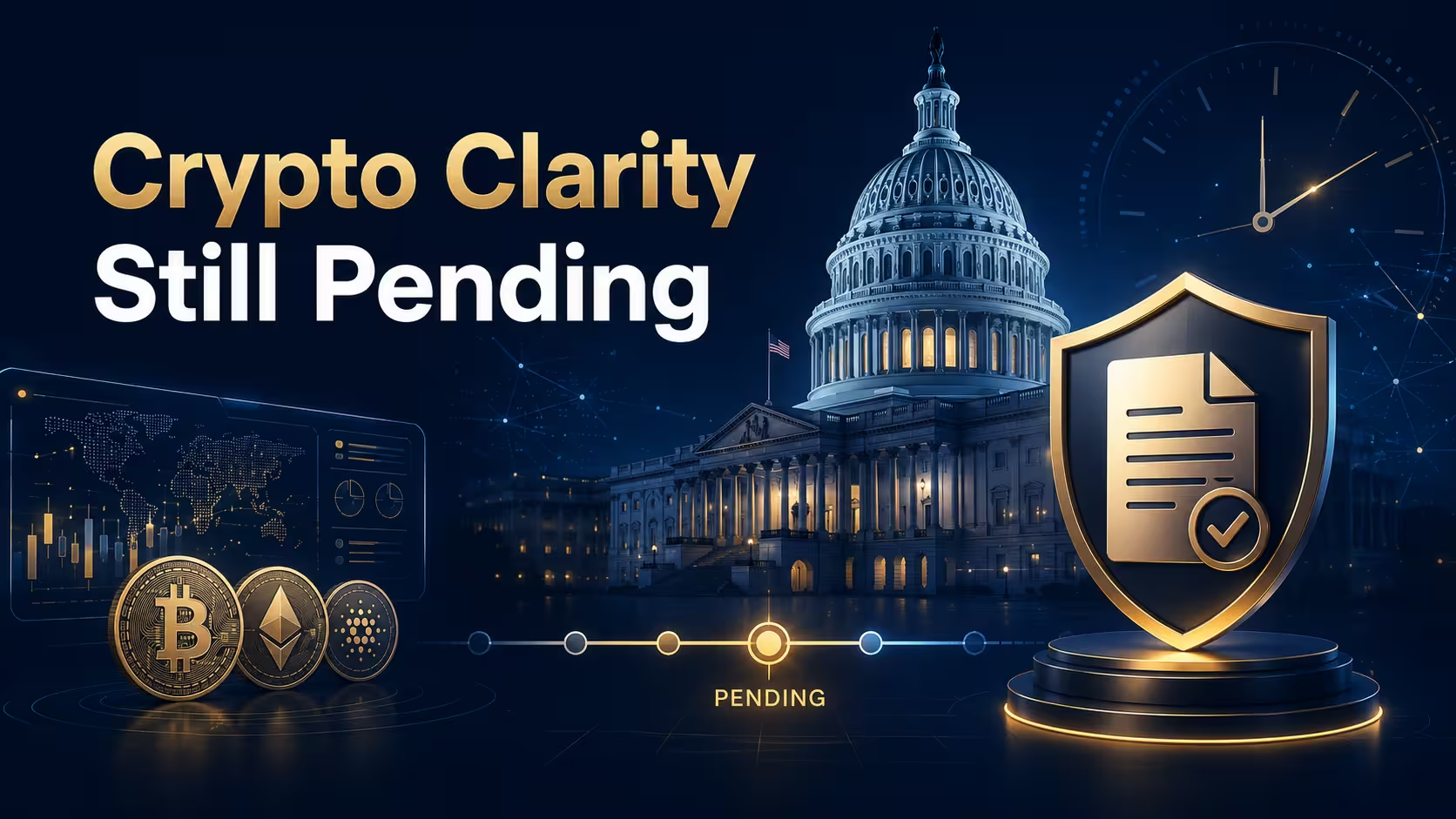
The CLARITY Act, U.S. Crypto Rules, and Why Aurum Users Are Still Waiting
One of the biggest questions people in the United States keep asking is simple:
When will crypto regulation finally become clear?
For people watching Aurum, AI finance, digital assets, Web3 wallets, and global crypto platforms, this question matters.
It matters because U.S. users often deal with more friction than users in other parts of the world.
Sometimes that means access issues.
Sometimes that means extra uncertainty.
Sometimes that means using privacy-focused tools, VPNs, Tor Browser, or alternative access methods just to reach platforms that may be easier to access elsewhere.
That naturally leads to the question:
When does this get fixed?
The honest answer is:
Not yet.
But progress is happening.
What Is the CLARITY Act?
The CLARITY Act, formally known as the Digital Asset Market Clarity Act, is a major U.S. crypto market structure bill designed to create clearer rules around digital assets.
The goal is to help define how digital assets should be treated, which regulators have authority, and how crypto platforms can operate within a clearer legal framework.
That matters because one of the biggest problems in the U.S. crypto market has been uncertainty.
For years, companies, exchanges, developers, investors, and users have dealt with unclear rules.
Is a token a security?
Is it a commodity?
Who regulates it?
What is allowed?
What creates compliance risk?
Those questions have created confusion across the industry.
The CLARITY Act is an attempt to bring more structure to that environment.
Where Does the CLARITY Act Stand Now?
The CLARITY Act has made real progress, but it is not law yet.
The House of Representatives passed H.R. 3633, the CLARITY Act, on July 17, 2025, by a bipartisan vote of 294-134. That was a major step for crypto market structure legislation in the United States.
Then, on May 14, 2026, the Senate Banking Committee advanced the bill in a 15-9 bipartisan vote, moving it closer to consideration by the full Senate. The Senate Banking Committee described the bill as legislation designed to establish clearer rules of the road for digital assets.
That sounds promising.
But there are still steps left.
The bill still needs full Senate consideration, potential amendments or reconciliation with House language, and ultimately a presidential signature before it becomes law.
So while the CLARITY Act is moving, it is not finished.
Why This Matters for U.S. Crypto Users
For U.S. users, this matters because the lack of regulatory clarity has created a messy environment.
Many crypto companies are cautious around the United States because the rules have not been clear enough.
Some platforms restrict access.
Some avoid U.S. users entirely.
Some operate differently depending on jurisdiction.
Some users end up relying on VPNs, Tor Browser, or other privacy tools because access can be inconsistent.
That is not ideal.
People want clear rules.
Companies want clear rules.
Users want to know where they stand.
And the industry needs a more stable framework if it wants to grow responsibly in the United States.
Why “A Date” Is Hard to Predict
A lot of people want a specific date.
They want to know when everything changes.
They want to know when U.S. access becomes easier.
They want to know when platforms can stop being careful.
But legislation does not usually work that neatly.
Even when a bill has momentum, it can still face delays.
The CLARITY Act has already passed the House and advanced through the Senate Banking Committee, but reports have noted that Senate negotiations remain active and passage is not guaranteed. Reuters reported that the bill still faces concerns from some Democrats around anti-money-laundering provisions and conflicts-of-interest issues, while banks have also pushed back on stablecoin-related provisions.
That means the bill can still change.
It can still slow down.
It can still face political pressure.
It can still miss expected timelines.
So the answer is not “next week” or “on this exact day.”
The better answer is:
The U.S. is moving toward clearer crypto rules, but the process is still unfinished.
Why This Connects to Aurum
This is important for people watching Aurum because Aurum sits inside the broader global digital asset industry.
Aurum is not operating in a vacuum.
AI-powered trading tools, Web3 wallets, stablecoins, crypto infrastructure, RWA products, and global digital asset platforms are all affected by regulation.
When regulation changes, platforms have to adapt.
When rules are unclear, platforms often have to be careful.
When countries create better frameworks, that can open doors for more structured access over time.
This is why I keep saying that people need to look beyond daily performance updates or income screenshots.
Those things may get attention.
But regulatory structure may be far more important long term.
The Industry Is Growing Up
Crypto is moving from the early experimental stage into a more mature financial technology environment.
That does not mean risk disappears.
It does not mean every platform succeeds.
It does not mean every user gains access everywhere.
But it does mean the industry is being forced to mature.
In Europe, MiCA is already creating a more formal regulatory environment.
In the United States, the CLARITY Act is part of the larger effort to define how digital assets should be handled.
This is the bigger shift:
The crypto industry is no longer just asking, “Can we build it?”
Now the question is also:
Can we operate it legally?
Can we scale it responsibly?
Can we protect users?
Can we meet compliance expectations?
Can we build infrastructure that survives regulation?
Those are the questions serious platforms need to answer.
Why U.S. Users Should Pay Attention
If you are in the United States and following Aurum, this matters.
Not because the CLARITY Act instantly solves everything.
It does not.
Not because passage is guaranteed.
It is not.
Not because every platform will suddenly be available everywhere.
That is not how regulation works.
But it matters because regulatory clarity can influence the entire digital asset landscape.
Clearer rules may eventually help platforms, users, developers, and financial technology companies operate with more confidence.
Until then, uncertainty remains part of the environment.
That is why users should be careful, informed, and patient.
What This Means Right Now
Right now, the practical takeaway is simple:
There is no confirmed date when U.S. users can stop dealing with access friction.
There is no confirmed date when every crypto platform will become easier to access from the United States.
There is no confirmed date when all uncertainty disappears.
The CLARITY Act has made progress, but it still needs to complete the legislative process.
That means users should continue to follow official updates, review credible sources, understand platform rules, and avoid making assumptions based on rumors or Telegram chatter.
Why Education Matters
This is exactly why education matters in crypto.
People hear one post and assume everything is fixed.
They hear one regulatory update and assume everything is legal everywhere.
They hear one date and assume that is the deadline.
But the truth is more complicated.
Crypto regulation is moving.
The U.S. is trying to create clearer digital asset rules.
But until laws are passed, signed, implemented, interpreted, and applied, there will still be uncertainty.
That is why beginners need plain-English explanations.
They need context.
They need risk awareness.
They need to understand the difference between momentum and finality.
A bill moving forward is not the same thing as a bill becoming law.
Why Join Through Stop Chasing Now?
Aurum provides the platform.
Stop Chasing Now helps people understand the process.
That includes platform education, onboarding guidance, setup help, wallet and funding explanations, risk reminders, and updates around the broader digital asset environment.
When someone joins through us, they get more than just a registration link.
They get beginner-friendly support, educational resources, marketing tools, AI follow-up support, live chat and voice support, and help avoiding common beginner mistakes.
That matters because crypto is not always simple.
Regulation is not always simple.
Access is not always simple.
Funding is not always simple.
And when people rush, they can make costly mistakes.
The goal is not to rush.
The goal is to understand.
Important Risk Reminder
This post is for educational purposes only.
Stop Chasing Now is not a financial advisor, investment advisor, tax advisor, legal advisor, or regulatory authority.
Aurum, AI-powered trading tools, digital assets, crypto platforms, Web3 wallets, stablecoins, VPNs, Tor Browser, regulatory transitions, and affiliate opportunities all involve risk.
Results are not guaranteed.
Past performance does not guarantee future results.
Regulatory progress does not remove market risk, platform risk, technology risk, jurisdictional risk, compliance risk, or personal decision-making risk.
You are responsible for understanding the laws, rules, platform terms, and risks that apply to you.
Always do your own research.
Review official information.
Never use money you cannot afford to lose.
Final Thoughts
The CLARITY Act is important because it shows the United States is moving toward clearer digital asset rules.
But it is not law yet.
That means U.S. crypto users are still waiting.
Aurum users are still watching.
The industry is still adapting.
And the bigger picture is still unfolding.
The good news is that crypto regulation is finally moving from vague debate toward more formal structure.
The frustrating part is that it takes time.
For now, the smartest move is to stay informed, stay patient, understand the risks, and avoid confusing progress with completion.
Clarity may be coming.
But it is not fully here yet.