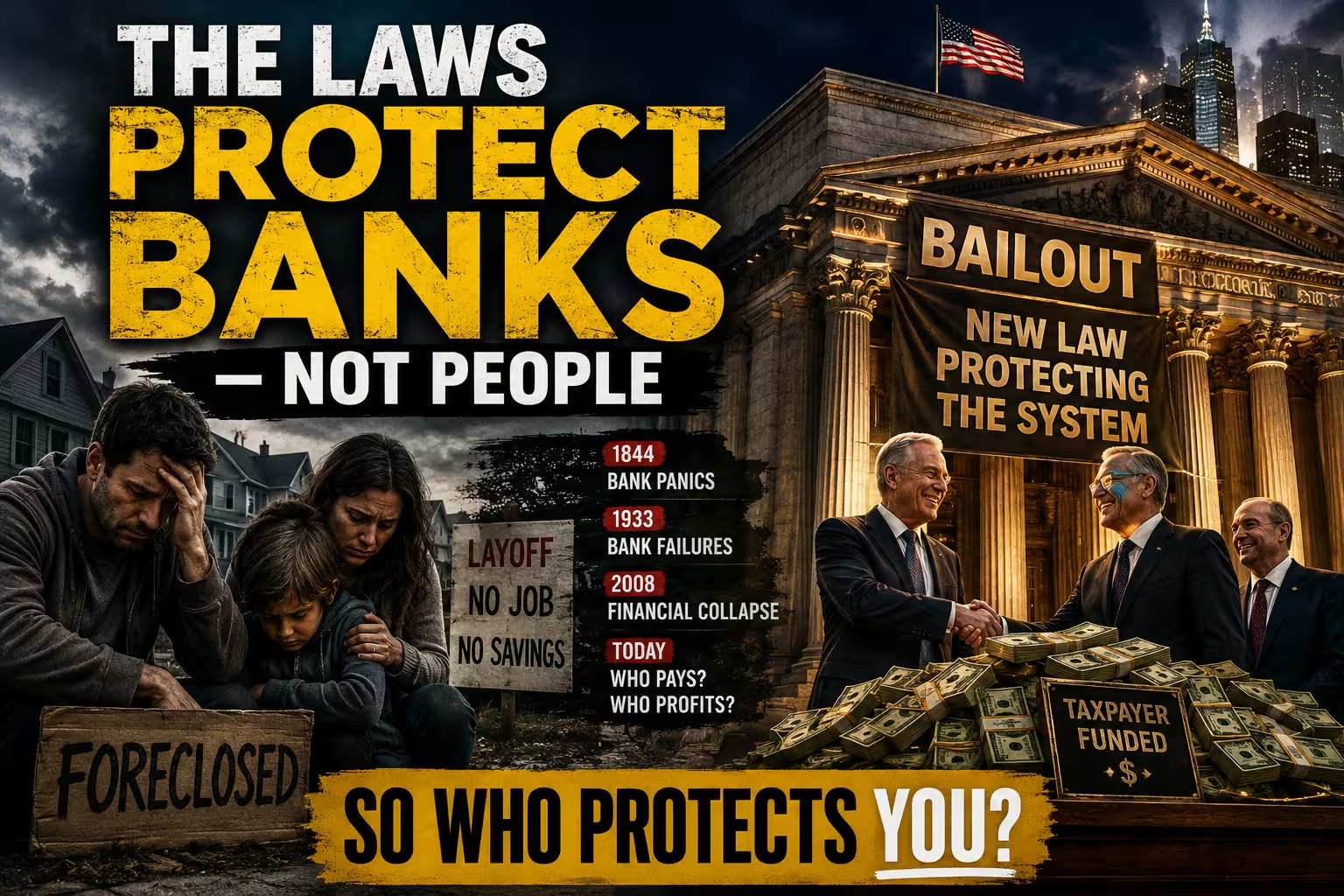
The Laws Protect Banks — So Who Protects You?
Every financial crisis seems to follow the same script.
First, the experts tell everyone not to panic.
Then the politicians rush to the microphones.
Then the banks act shocked.
Then new laws are passed with words like protection, stability, reform, safety, and accountability.
And every time, regular people are told the same thing:
This is for your own good.
But a lot of people are starting to ask a different question.
If these laws are really written to protect the people, why do the people always seem to lose?
Why do families lose homes?
Why do savers get punished?
Why do small businesses get squeezed?
Why do taxpayers foot the bill?
Why do banks get rescued while ordinary people are told to tighten their belts?
That is the question more people are waking up to.
The System Always Says It Is Protecting You
The financial system has mastered one skill better than almost anything else:
Language.
When banks are in trouble, they do not call it a bank rescue.
They call it financial stability.
When taxpayers are used to absorb losses, they do not call it a bailout for bad decisions.
They call it protecting the economy.
When regular people are squeezed by inflation, interest rates, fees, taxes, and limited options, they are told it is necessary.
Necessary for what?
Necessary for whom?
Because from where many regular people are sitting, it feels like the system has one rule for the institutions and another rule for everyone else.
When ordinary people make mistakes, they pay.
When banks make mistakes, the system reorganizes itself to keep them standing.
That is why this topic hits such a nerve.
People are tired of being told that everything is designed to protect them when the results keep showing something different.
The Public Gets the Slogans. The Banks Get the Safety Net.
After every major financial crisis, the public is given a story.
The story usually sounds something like this:
We learned our lesson.
This will never happen again.
New safeguards are in place.
The people are protected.
But history raises a harder question.
Were the people protected?
Or was confidence in the system restored just enough to keep people participating?
That is the uncomfortable part.
Because when you look at financial history, a pattern appears.
Banks take risks.
The system becomes unstable.
The public gets scared.
The government steps in.
New rules are written.
The banks survive.
And the people carry the cost.
Sometimes that cost comes through taxes.
Sometimes through inflation.
Sometimes through lost purchasing power.
Sometimes through austerity.
Sometimes through foreclosures.
Sometimes through limited access to real financial alternatives.
The language changes.
The pattern does not.
2008 Taught Millions of People a Lesson They Never Forgot
For a lot of people, 2008 was the moment the illusion broke.
Millions of ordinary families watched the financial system crack.
Homes were lost.
Jobs disappeared.
Retirement accounts were damaged.
Small businesses struggled.
People who had done what they were told — work hard, save money, buy a home, trust the system — suddenly realized the system was not built the way they thought it was.
And then came the rescue.
But it did not feel like a rescue for the average person.
It felt like the people who helped create the crisis were saved first, while everyone else was left to deal with the damage.
That is why the anger has never fully gone away.
People remember.
They remember watching banks get support while families got foreclosure notices.
They remember being told the economy had to be saved, while their own household economy was falling apart.
They remember the lectures about responsibility coming from institutions that had just been rescued.
That kind of memory does not disappear.
It turns into distrust.
Why People Feel “Scammed”
When people say they feel scammed by the financial system, they are not always talking about one specific event.
They are talking about the pattern.
They are talking about being told to trust institutions that do not seem to trust them back.
They are talking about being told banks are safe while fees, inflation, and low yields slowly drain their progress.
They are talking about watching large institutions receive special treatment while regular people are expected to absorb the consequences.
They are talking about working harder and still feeling behind.
They are talking about saving money and watching purchasing power shrink.
They are talking about realizing that the old playbook may not be enough anymore.
That is the pain point.
People do not just want more money.
They want more control.
They want more transparency.
They want more options.
They want a way to stop feeling trapped inside a system that always seems to protect itself first.
“Protection” Often Means Protecting the System
This is where the language gets tricky.
When officials say they are protecting the economy, what do they really mean?
Are they protecting people?
Or are they protecting the institutions that control credit, lending, payments, markets, and money flow?
Because those are not always the same thing.
Protecting the banking system may keep the financial machine running.
But that does not mean the average person is made whole.
A family that lost a home does not feel protected.
A worker who lost a job does not feel protected.
A retiree whose savings got crushed does not feel protected.
A small business that closed its doors does not feel protected.
So when people hear “this law protects the public,” they are right to ask:
How?
Who benefits first?
Who carries the risk?
Who gets rescued?
Who pays?
Those are the questions financially awake people ask.
The Real Lesson Is Not to Hate Banks
The point is not that every bank is evil.
The point is not that every law is useless.
The point is not that people should panic, withdraw everything, or make reckless decisions.
That would be the wrong lesson.
The real lesson is this:
You cannot outsource your financial future to institutions that are designed to protect themselves first.
You need to understand the system.
You need to understand risk.
You need to understand inflation.
You need to understand digital assets.
You need to understand why diversification matters.
You need to understand why financial education matters.
You need to understand why depending on one system, one bank, one paycheck, one employer, or one retirement account may no longer be enough.
The old advice was simple:
Work hard.
Save money.
Trust the bank.
Wait for retirement.
But millions of people are starting to realize that may not be enough in the world we live in now.
Why Digital Assets Enter the Conversation
This is one reason digital assets have become so interesting to so many people.
Crypto did not become popular only because people wanted speculation.
It became popular because people were looking for alternatives.
They wanted a system where access did not depend entirely on banks.
They wanted assets that could move globally.
They wanted more transparency.
They wanted self-custody.
They wanted programmable finance.
They wanted financial tools that were not completely controlled by legacy institutions.
Now, digital assets are not perfect.
Crypto carries real risk.
Platforms can fail.
Markets can be volatile.
Scams exist.
Technology can be confusing.
Wallet mistakes can be costly.
Regulation is still evolving.
So this is not about pretending crypto solves everything.
It does not.
But it is about understanding why people are looking.
People are not just chasing trends.
Many are trying to escape a financial system they no longer fully trust.
Where Aurum Fits Into This Bigger Shift
This is why I continue paying attention to Aurum.
Aurum sits at the intersection of several major trends:
AI-powered financial tools.
Digital assets.
Automation.
Web3 wallets.
Real-world asset strategies.
Crypto infrastructure.
Passive income potential.
Active income opportunities.
A broader shift toward financial tools outside the old banking model.
For many people, Aurum is interesting because it offers access to AI-powered tools and digital asset income potential.
But the bigger picture is not just income.
The bigger picture is options.
In a world where people increasingly distrust traditional systems, they are looking for ways to understand new tools, participate in new financial technology, and build outside the limits of the old model.
That does not mean Aurum is risk-free.
It is not.
That does not mean results are guaranteed.
They are not.
That does not mean people should rush in blindly.
They should not.
But it does mean the conversation matters.
Because the financial world is changing, and people are hungry for alternatives.
The Pain Is Real
A lot of people are tired.
Tired of working harder and falling behind.
Tired of being told inflation is under control while groceries, insurance, housing, and basic life keep getting more expensive.
Tired of watching banks get help while families get lectures.
Tired of hearing that the system is strong while their own finances feel fragile.
Tired of being told to trust institutions that seem to benefit no matter who loses.
That pain is real.
And ignoring it does not make it go away.
People want answers.
They want education.
They want tools.
They want access.
They want a path.
They want to feel like they are not just sitting on the sidelines while the financial system keeps changing the rules.
Financial Freedom Starts With Seeing Clearly
The first step toward financial freedom is not joining a platform.
It is not buying crypto.
It is not opening a wallet.
It is not chasing a return.
The first step is seeing clearly.
Seeing that the system is not neutral.
Seeing that financial laws often protect institutions first.
Seeing that “safe” does not always mean what people think it means.
Seeing that inflation can quietly punish savers.
Seeing that dependence creates vulnerability.
Seeing that education is no longer optional.
Once you see that, you can start making better decisions.
Not emotional decisions.
Not desperate decisions.
Not reckless decisions.
Better decisions.
Informed decisions.
Responsible decisions.
Why Education Comes Before Action
This is exactly why Stop Chasing Now exists.
Aurum provides the platform.
Stop Chasing Now helps people understand the process.
We help people slow down, learn the basics, understand the setup, understand the risks, and avoid common beginner mistakes.
That includes education around:
AI-powered financial tools.
Digital assets.
Stablecoins.
Web3 wallets.
Funding basics.
Platform navigation.
Risk awareness.
Passive income potential.
Active income opportunities.
Marketing and follow-up support.
Responsible onboarding.
Because the last thing people need is another system they do not understand.
If someone is frustrated with banks, inflation, government policy, or the old financial model, that frustration is valid.
But frustration alone is not a strategy.
Education is the bridge between frustration and action.
Do Not Trade One Blind Trust for Another
This part matters.
If you are frustrated with the banking system, do not simply trade blind trust in banks for blind trust in crypto.
That is not the answer.
Do not blindly trust any platform.
Do not blindly trust any influencer.
Do not blindly trust any screenshot.
Do not blindly trust any opportunity.
Do your own research.
Ask questions.
Understand the risks.
Understand how wallets work.
Understand how funding works.
Understand that digital assets can go up and down.
Understand that AI-powered tools still involve risk.
Understand that passive income is never guaranteed.
Understand that affiliate income requires effort and is not guaranteed.
Real financial independence requires personal responsibility.
That is the part many people skip.
But it is the part that matters most.
Why This Moment Matters
We are living through a major financial transition.
The old system is still powerful.
Banks still matter.
Governments still matter.
Regulation still matters.
But people are more aware than ever.
They are asking better questions.
They are looking for alternatives.
They are learning about digital assets.
They are exploring AI finance.
They are becoming more skeptical of promises made by institutions that have failed them before.
That shift is not going away.
The question is whether people will respond with fear or education.
I believe education wins.
Important Risk Reminder
This post is for educational purposes only.
Stop Chasing Now is not a financial advisor, investment advisor, tax advisor, legal advisor, or banking authority.
Aurum, AI-powered trading tools, digital assets, crypto platforms, Web3 wallets, stablecoins, regulatory transitions, and affiliate opportunities all involve risk.
Results are not guaranteed.
Past performance does not guarantee future results.
Digital assets can be volatile.
Platform access and rules can change.
Regulatory environments can change.
You are responsible for understanding the risks, rules, laws, platform terms, and decisions that apply to you.
Never use money you cannot afford to lose.
Always do your own research before creating an account, funding, trading, withdrawing, or participating in any opportunity.
Final Thoughts
The laws may say they protect the public.
But history has shown that the financial system often protects itself first.
That does not mean you are powerless.
It means you need to stop outsourcing your financial future to promises you did not write, rules you do not control, and institutions that may not have your best interest at the center.
You need education.
You need awareness.
You need options.
You need to understand the system well enough to make informed decisions outside of fear.
That is why this conversation matters.
Because the people who keep waiting for the system to save them may keep getting disappointed.
But the people who learn, adapt, and build around new tools may have a very different future.
The system protects itself.
The question is:
Who is protecting you?