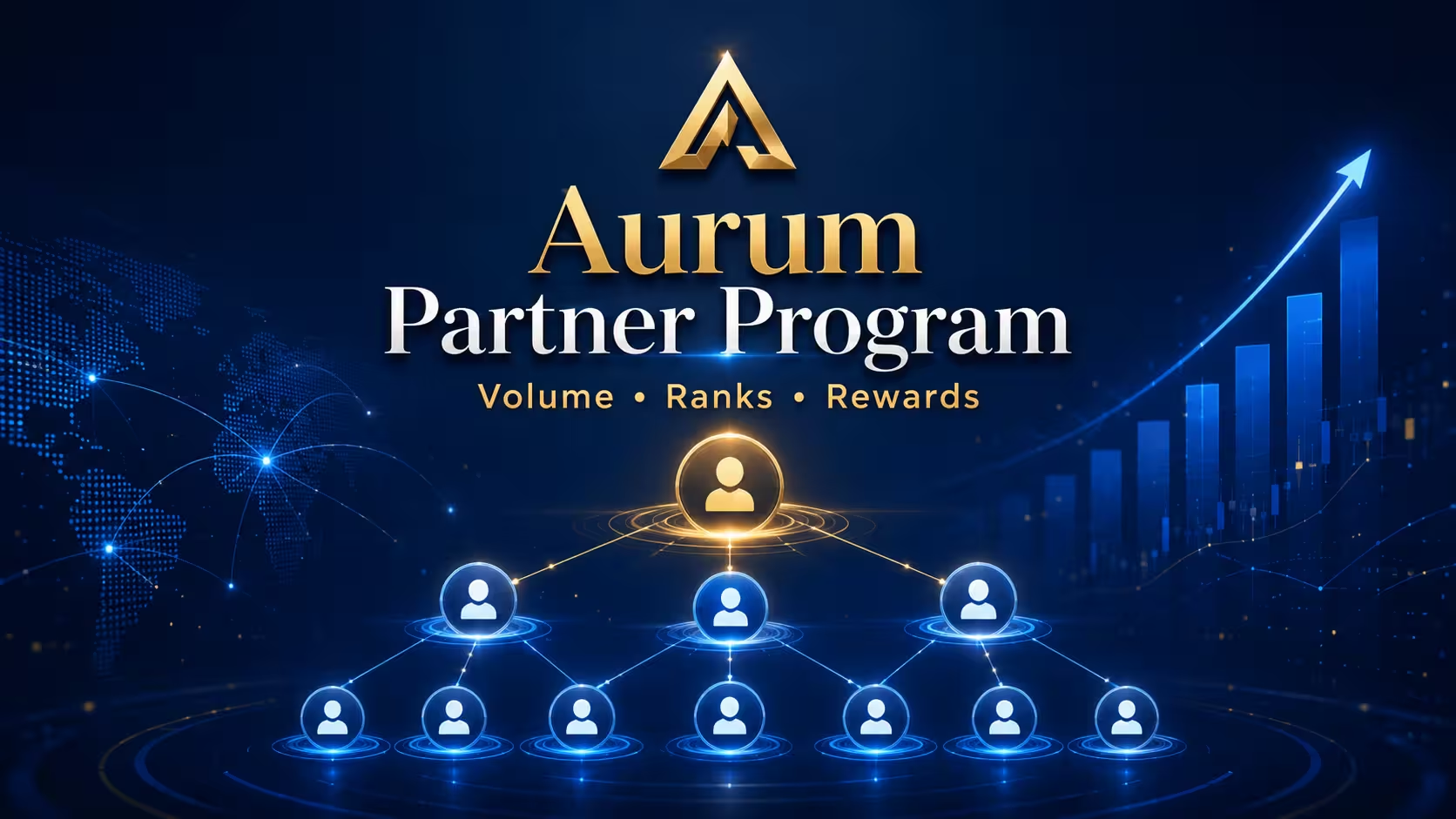
Aurum Partner Program Explained: Legacy Volume, Rankings, Differentials, and Compensation Plan Basics
Aurum is often discussed because of its AI-powered trading tools, digital asset products, EX-AI Bot, RWA opportunities, and passive income potential.
But there is another side of Aurum that many people want to understand better:
The Partner Program.
For people who are interested in the active income side, this matters.
The Partner Program is the part of Aurum that allows users to share the platform, build a team, help others understand the ecosystem, and potentially earn referral-related compensation.
This is not the same as passive trading income.
This is the active side.
And like anything involving compensation, ranks, volume, and team structure, it is important to slow down and understand how it works before making assumptions.
Passive Income Side vs. Active Income Side
Aurum has two very different conversations happening at the same time.
The first conversation is the passive side.
That is where people may be looking at AI-powered trading tools, EX-AI Bot, RWA products, automation, digital asset strategies, and the potential to generate income from platform activity.
The second conversation is the active side.
That is where people choose to share Aurum with others.
The active side may include prospecting, education, follow-up, onboarding, team building, and helping others understand both the opportunity and the risks.
The Partner Program belongs to the active side.
That means it requires effort.
It requires communication.
It requires leadership.
It requires follow-up.
And it requires a responsible approach.
No one should look at a compensation plan and assume income is automatic.
The Basic Idea of the Aurum Partner Program
The Aurum Partner Program is designed to reward people who share the platform and help build volume through their organization.
A key point from the compensation explanation is that the plan includes direct commissions and rank-based differential income.
In simple language, that means your rank may determine your percentage, and when people below you reach certain ranks, the system may pay the difference between your percentage and theirs, depending on the structure.
For example, the transcript explains that if someone reaches Vanguard and has a Voyager below them, the Voyager may receive 5%, while the Vanguard may receive the difference between 7% and 5%, which is a 2% differential on that volume. The same explanation says these differentials can work up and down the compensation plan.
That concept is important because it shows the plan is not only about who personally enrolled someone.
It is also about rank, team structure, volume, and how far people advance inside different legs of the organization.
What Is Legacy Volume?
One of the most important terms in the Partner Program is legacy volume.
Legacy volume is used as part of the ranking and qualification structure.
In the transcript, the speakers discuss how volume can help someone move through ranks, starting with the idea that generating $7,500 of total volume can promote someone to Voyager and increase direct commission from 3% to 5%.
For beginners, the main idea is this:
Volume helps determine rank.
Rank helps determine compensation percentages.
Structure helps determine whether someone qualifies for higher ranks.
That is why it is important to understand both volume and placement.
A person may have volume in one leg, but certain higher ranks may require volume or ranked partners in separate legs.
That is why the Partner Program is not just about “getting signups.”
It is about building a more balanced organization.
Ranks Matter Because Percentages Matter
In a simple affiliate program, a person might earn the same percentage forever.
Aurum’s Partner Program appears to be more rank-based.
The transcript discusses examples where someone at Nova can move to Voyager, then toward Vanguard, then Vanguard Pro, with higher ranks connected to higher direct commission percentages and differentials. The example given explains that Voyager can move direct commission from 3% to 5%, Vanguard can move it to 7%, and Vanguard Pro is discussed as earning 9% on direct volume.
The important beginner takeaway is this:
Higher rank may create higher earning potential, but rank usually requires structure and volume.
That means the active side rewards building, not just joining.
It also means that results will vary based on effort, timing, team development, market conditions, platform rules, and individual execution.
How Differentials Work
Differentials are one of the most important concepts in the plan.
A differential is basically the difference between your rank percentage and the rank percentage of someone below you.
For example, if you are at a rank that pays 7% and someone below you is at a rank that pays 5%, the difference is 2%.
That 2% is the differential.
The transcript explains that these differentials can continue through depth until the system reaches someone at the same rank or a higher rank, at which point the differential may stop or be blocked.
This is important because it encourages leaders to help people rank up.
If someone below you grows, that can help your volume and structure.
But if they reach your same rank or higher, they may begin receiving the compensation below them instead of you receiving the differential through that point.
That is not necessarily a bad thing.
It means people can grow beyond their upline.
From a leadership standpoint, that can be healthy because it rewards real builders.
Why “Blocking” Matters
The transcript discusses the idea that when someone below you reaches the same rank as you, the differential stops at that point. It also explains that if someone exceeds your rank, you would not receive a differential beyond that person.
This is sometimes called a block.
For beginners, think of it this way:
If you are ranked higher than someone below you, you may receive the difference between your rank percentage and their rank percentage.
If they catch up to your rank, there may no longer be a difference to pay.
If they pass you, they are now operating at a higher rank than you.
This is why rank advancement matters.
It is also why leadership and duplication matter.
The goal is not just to enroll people.
The goal is to help people understand the platform, build correctly, and develop leaders.
Why Multiple Legs Matter
One major lesson from the transcript is that building multiple legs can matter more than simply building one deep line.
The speakers explain that after Voyager, a person may need two Voyagers in separate lines to advance toward Vanguard, and that the organization begins to require more structure as ranks increase.
This is an important point.
A person can have a lot of volume in one leg and still need additional qualifying structure elsewhere.
That is common in many rank-based plans.
The purpose is usually to reward balanced team development instead of one single line carrying everything.
For someone building the active side of Aurum, this means the focus should not only be depth.
It should also be leadership development across multiple lines.
Should You Place People Deep or Keep Them Frontline?
The transcript includes an important discussion about placing people deep versus keeping people personally sponsored.
The speaker argues that when you personally do the work to bring someone in, placing that person deep under someone else may reduce the full benefit of your own effort, and that the plan is weighted toward personal activity and personal sales in certain ways.
That is a practical leadership point.
Some people in network marketing think they should place everyone under others to “build depth.”
But depending on the plan, that may not always be the best strategy.
In Aurum’s case, based on this explanation, personal activity appears to matter.
That does not mean there is only one correct placement strategy.
But it does mean people should understand the plan before randomly placing volume.
Rank Bonuses
Another part of the Partner Program discussed in the transcript is one-time rank bonuses.
The transcript explains that when someone advances to Voyager, a $100 bonus may be dropped into the main wallet automatically, and that rank bonuses increase at higher ranks.
This is separate from direct commissions or differential income.
Rank bonuses are designed to reward rank advancement.
That means a person may receive a one-time bonus when they hit a qualifying rank.
Again, this should not be treated as guaranteed income.
Rank advancement requires qualification.
Qualification requires volume, structure, and activity.
Not everyone will qualify.
Shareholder Bonus / Profit Pool Concept
The transcript also discusses a shareholder-style bonus or pool that begins at higher ranks.
The explanation says that at Oracle, leaders are considered in connection with a shareholder-style pool, where company profits are allocated into rank-based pools and distributed among qualified leaders at those ranks.
This is a more advanced part of the plan.
For beginners, the simple explanation is:
At certain higher ranks, there may be additional company-level profit pool participation.
That type of bonus is not something a beginner should focus on first.
The beginner focus should be:
Understand the platform.
Understand the risks.
Learn the products.
Share responsibly.
Build skill.
Help people onboard correctly.
Develop qualified leaders.
The advanced pools may become relevant later for serious builders who reach those levels.
The Biggest Lesson: This Is an Active Business
The most important takeaway from the entire compensation discussion is that the Partner Program is not passive.
The passive side may involve AI-powered tools, trading products, and digital asset strategies.
The active side requires action.
That includes:
Talking to people.
Inviting people to review information.
Following up.
Helping prospects understand the platform.
Onboarding new users.
Helping people avoid setup mistakes.
Teaching people how to share ethically.
Supporting a team.
Building multiple lines.
Helping others grow.
That is a real business-building process.
It is not automatic.
It is not guaranteed.
It is not something people should approach casually if they want serious results.
Why This Matters for Stop Chasing Now
This is exactly why Stop Chasing Now exists.
Aurum provides the platform.
Stop Chasing Now helps people understand it, share it, and build around it.
When you join through us, you get more than a registration link.
You get beginner-friendly onboarding, setup guidance, educational resources, wallet and funding explanations, marketing support, follow-up help, AI-assisted tools, live chat and voice support, and help avoiding common beginner mistakes.
This matters because compensation plans can be confusing.
Crypto setup can be confusing.
Wallets and stablecoins can be confusing.
Talking to prospects can be confusing.
Following up can be uncomfortable.
Building a team can feel overwhelming without a clear process.
Our goal is to help people approach Aurum with clarity, professionalism, and risk awareness.
Important Income and Risk Reminder
This post is for educational purposes only.
Stop Chasing Now is not a financial advisor, investment advisor, tax advisor, legal advisor, or official compliance authority.
Aurum, AI-powered trading tools, digital assets, crypto, Web3 wallets, affiliate opportunities, and compensation plans all involve risk.
Income is not guaranteed.
Rank advancement is not guaranteed.
Bonuses are not guaranteed.
Past performance does not guarantee future results.
Compensation examples are for educational purposes only and should not be considered typical, promised, or guaranteed.
Individual results will vary based on personal effort, timing, market conditions, platform activity, team development, compliance rules, product usage, leadership ability, and many other factors.
Never use money you cannot afford to lose.
Always review official Aurum information, understand the risks, and make your own informed decision before creating an account, funding, trading, promoting, or participating in any affiliate opportunity.
Final Thoughts
Aurum’s Partner Program can be powerful, but it needs to be understood properly.
The key concepts are:
Direct commissions.
Legacy volume.
Rank advancement.
Differentials.
Multiple legs.
Blocking.
Rank bonuses.
Leadership development.
Active income through real effort.
The biggest mistake someone can make is assuming the compensation plan works automatically.
It does not.
The active side rewards people who learn, communicate, follow up, onboard, support, and build responsibly.
If you are only interested in passive income, focus on understanding the platform and the risks.
If you are interested in the active income side, learn the Partner Program carefully.
Because the people who understand the structure are usually the ones who can explain it better, build it more professionally, and help others avoid confusion.