Bryan Benson’s 10-Year Aurum Roadmap: The Vision, the Milestones, and What Still Needs to Be Proven
Most financial platforms talk about the next product launch, the next quarter, or the next marketing campaign.
Aurum Foundation has presented something considerably larger: a ten-year plan intended to transform the platform from an AI-powered trading ecosystem into a global financial technology network.
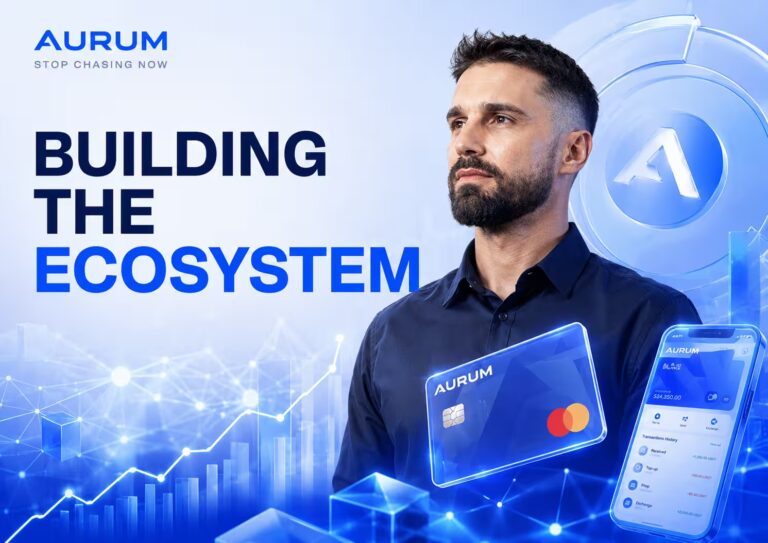
In a presentation delivered in 2025, Aurum CEO Bryan Benson outlined a roadmap extending through 2035. It included an exchange, digital banking tools, payment cards, artificial intelligence, tokenized real-world assets, ATMs, point-of-sale terminals, decentralized finance, and an eventual financial “super app.”
It was an ambitious presentation.
Now that time has passed, however, the most useful way to revisit it is not simply to repeat every projection. It is to examine what Aurum says it intends to build, what appears to be moving forward, and what still needs to be independently demonstrated.
That distinction matters.
A roadmap is not a promise of results. It is a public statement of direction—and a standard against which future execution can be measured.
Aurum’s Vision Goes Far Beyond One Trading Product
Many people first encounter Aurum through its AI-powered trading and liquidity-management products.
Benson’s presentation made it clear that the larger vision is not supposed to stop there.
He described Aurum as an interconnected financial ecosystem in which different products support one another:
- AI-powered trading and liquidity-management tools
- A centralized cryptocurrency exchange
- A future decentralized exchange
- Aurum NeoBank and payment cards
- Cryptocurrency-to-fiat spending infrastructure
- Point-of-sale terminals for merchants
- Aurum-connected ATMs
- Tokenized real estate and other real-world assets
- Business and institutional financial products
- A future financial lifestyle “super app”
The goal, according to the presentation, is to create an environment where users can potentially manage, trade, earn, transfer, and spend digital assets without relying on a collection of disconnected platforms.
That is the central idea behind the roadmap.
Aurum does not appear to be positioning itself as merely a trading-bot company. It is attempting to position itself as a broader bridge between artificial intelligence, blockchain technology, payments, digital banking, and everyday financial activity.
Phase One: Building the Foundation
The earliest stage of the roadmap focused on developing the core components of the ecosystem.
These included the Aurum Exchange, the NeoBank application, payment cards, liquidity products, trading technology, and the infrastructure required to connect them.
The Aurum Exchange
The proposed exchange plays a central role in the roadmap.
Benson described an environment supporting spot trading, derivatives, real-time trading tools, liquidity programs, and connections to other Aurum products.
In theory, this could make moving between different assets easier for users already operating inside the ecosystem. Instead of sending funds to multiple outside platforms, users could potentially exchange assets and deploy them into other Aurum products from one connected account.
The longer-term plan also includes a decentralized exchange, or DEX, intended to expand Aurum’s presence within decentralized finance.
These are significant ambitions. Building an exchange is not simply a matter of creating a trading interface. It requires liquidity, cybersecurity, risk controls, reliable execution, custody arrangements, regulatory permissions, and enough sustained trading activity to make the platform useful.
Those are areas where continued transparency will be important.
Aurum NeoBank and Payment Cards
The roadmap also placed substantial emphasis on connecting cryptocurrency with everyday spending.
Aurum’s current website promotes its cards and NeoBank as a unified system for accessing, managing, and spending crypto and fiat assets. The website describes multiple card levels, virtual and physical options, and a broader financial application. These descriptions are company-provided and should be evaluated accordingly.
There is also an Aurum NeoBank application listed on Google Play. The listing says users can fund accounts with USDT, make online and in-store payments, withdraw cash from ATMs, and manage card security. Google Play reports that the application was updated on May 13, 2026.
That is evidence that at least part of the proposed infrastructure has progressed beyond a presentation slide.
It does not independently verify every function, geographic availability, transaction limit, issuing arrangement, or regulatory status. However, it does show that development activity has continued.
Connecting Aurum With the Physical Economy
One of the more interesting parts of the roadmap involves bringing Aurum outside the digital environment.
Benson discussed both point-of-sale terminals and ATM machines.
Point-of-Sale Terminals
The proposed Aurum terminals would allow participating businesses to accept different forms of payment, potentially including traditional cards, Aurum cards, and selected cryptocurrencies.
The strategic purpose is clear: increase the number of places where Aurum-connected assets can be used.
If successfully deployed at scale, merchant terminals could produce real transaction activity rather than relying only on people purchasing or participating in financial products.
The challenge will be execution.
Payment hardware requires merchant adoption, processing relationships, technical support, fraud protection, jurisdiction-specific compliance, and dependable settlement. Demonstrating real-world terminal locations and transaction volumes would therefore be an important future milestone.
Aurum ATMs
The roadmap also described ATMs supporting cash deposits and withdrawals while connecting with Aurum’s digital balances.
Again, the vision is understandable. One of the largest obstacles to mainstream cryptocurrency use is moving conveniently between digital assets and the traditional financial system.
A functioning ATM network could help address that challenge.
But an ATM strategy also raises practical questions about banking relationships, cash management, local operating permissions, fees, security, availability, and geographic coverage.
The idea is compelling. The scale and implementation still need to be demonstrated.
Real-World Assets and Tokenized Property
Aurum’s roadmap extends into real-world asset tokenization, beginning with property.
Real-world assets, often shortened to RWAs, are physical or traditional financial assets represented through blockchain-based ownership or investment structures.
The presentation discussed giving users access to tokenized real estate, initially involving property in Dubai. Benson also introduced a proposed model in which a portion of participating capital would be directed toward property development, another portion toward AI-managed strategies, and another portion toward partner compensation.
The purpose would be to combine potential property appreciation with potential financial activity while construction is underway.
This is one of the roadmap’s most innovative concepts, but it is also one of the areas requiring the greatest legal and financial clarity.
Before participating in any tokenized-property opportunity, people should understand:
- What they legally own
- Which company holds title to the property
- Whether the token represents equity, debt, revenue rights, or something else
- Which jurisdiction governs the transaction
- Whether investor protections apply
- How valuations are established
- What happens if construction is delayed
- Whether and how the token can be resold
- What fees, restrictions, and counterparty risks are involved
Tokenization can make assets more accessible and transferable. It does not eliminate the legal, construction, liquidity, or market risks associated with the underlying property.
From a Financial App to a “Super App”
The later stages of the roadmap become much more ambitious.
Benson described Aurum evolving into a financial super app that could combine banking, payments, investments, travel, transportation, food delivery, insurance, real estate, and other everyday services.
The analogy would be an application where users could manage money and purchase services without leaving one integrated ecosystem.
This model has worked in parts of the world where large applications combine payments with transportation, shopping, communications, and financial services.
For Aurum, reaching that stage would require more than technology. It would require major partnerships, regulatory relationships, consumer trust, global support systems, and millions of users who regularly use the platform for more than passive participation.
That is why the roadmap should be viewed as a sequence.
The super-app vision becomes realistic only if the earlier infrastructure—cards, payments, exchange activity, merchant acceptance, banking access, and customer support—works reliably first.
The 2033–2035 “Unicorn Era”
Benson called the final stage of the plan the “unicorn era.”
In startup terminology, a unicorn is a privately held company valued at more than $1 billion.
Aurum’s long-term objectives include becoming a major global neobank, operating a highly ranked exchange and decentralized platform, managing billions of dollars through AI and real-world assets, issuing millions of cards, and supporting users through offices and payment locations around the world.
Benson also discussed a mission to help create 1,000 new millionaires through savings, compounding, yield-producing assets, and participation in the ecosystem.
That mission is motivational, but it must be interpreted responsibly.
No company can guarantee that an individual will become a millionaire. Results would depend on starting capital, time, risk, market conditions, product performance, personal activity, fees, withdrawals, tax consequences, and many other variables.
The most responsible way to interpret the statement is as an aspirational company goal—not a promise of personal financial results.
What Appears to Have Progressed?
A year after the presentation, there are signs of continued development.
Aurum’s website currently states that the ecosystem has launched eight technology products, has more than 170,000 active partners, holds four international licenses, and manages approximately $150 million in assets. These are Aurum’s own reported figures and were not independently audited or verified for this article.
The website now publicly describes several parts of the proposed ecosystem, including:
- Liquidity-management bots
- The Neyro non-custodial trading system
- Aurum Exchange
- Cards and NeoBank services
- Real-world asset technology
The existence of the NeoBank application on Google Play is another visible development.
These developments matter because they suggest the roadmap has not remained entirely theoretical.
At the same time, a product page, application listing, or company-reported statistic is not the same as independent verification of performance, licensing, liquidity, customer funds, or long-term sustainability.
Both sides of that statement can be true:
Aurum may be actively building real technology, and potential participants should still verify important claims before risking capital.
Regulatory Warnings Cannot Be Ignored
Any honest 2026 review of Aurum must also address the regulatory warnings that have appeared since the original roadmap presentation.
On June 12, 2026, France’s Autorité des Marchés Financiers placed aurum.foundation on its cryptocurrency blacklist, stating that the company offers financial services or products without authorization in France.
On June 22, 2026, Hong Kong’s Securities and Futures Commission added Aurum Foundation Limited to its alert list. The SFC stated that Aurum was not licensed by the regulator and was suspected of conducting unlicensed activities involving virtual assets, futures contracts, and derivatives in Hong Kong.
On May 14, 2026, New Zealand’s Financial Markets Authority recommended caution when dealing with Aurum Foundation. Its notice referenced warnings issued by overseas regulators concerning Aurum and its AI trading services.
Nigeria’s Securities and Exchange Commission issued a more strongly worded notice in January 2026. It stated that Aurum Bot was not registered or licensed to solicit investments or operate within the Nigerian capital market. The Nigerian SEC also said its investigation found characteristics commonly associated with fraudulent Ponzi schemes and advised the public not to invest through the platform for activity connected to Nigeria’s capital market.
These warnings should not be hidden, minimized, or explained away with marketing language.
They do not answer every question about every Aurum entity, product, or country. Regulatory permissions can differ by jurisdiction and by the specific service being offered.
However, the notices are significant.
Anyone considering Aurum should determine whether the particular service they intend to use is legally available and appropriately authorized in their own country. A company registration, commercial license, or corporate certificate is not necessarily the same as authorization to offer investments, derivatives, banking, or virtual-asset services.
Aurum should also be given the opportunity to respond publicly and specifically to these notices, clarify which legal entities operate each product, and explain what licensing or compliance changes are being pursued.
Greater transparency would benefit both the company and its community.
The Questions Serious Participants Should Ask
The correct response to uncertainty is not automatic rejection or blind belief.
It is better due diligence.
Before committing significant funds, potential users should consider asking:
Who Holds the Funds?
Is capital held directly by Aurum, by an exchange, through a broker, in a smart contract, or under the user’s control?
Can Performance Be Independently Verified?
Are trading results supported by verifiable statements, audited reports, blockchain records, brokerage data, or independent third-party reporting?
Screenshots and dashboard balances can be useful, but they are not the strongest form of verification.
Which Entity Provides Each Service?
The exchange, cards, NeoBank, AI products, and real-world assets may involve different legal entities, partners, or jurisdictions.
Users should understand exactly which organization they are contracting with.
What Protections Apply?
What happens if an account is frozen, a withdrawal is delayed, a technology provider fails, a counterparty becomes insolvent, or a regulator restricts the service?
Are Withdrawals Working Consistently?
Reliable withdrawals over time are one of the most important practical indicators of a functioning financial platform.
Are Roadmap Deadlines Being Met?
Delays are common in financial technology, but repeated delays without clear explanations deserve attention.
A good roadmap should allow the public to compare announced milestones with real delivery.
Why the Roadmap Still Matters
Despite the unresolved questions, Benson’s presentation is still worth examining.
It provides context.
It shows that Aurum’s leadership is attempting to build something broader than a single trading product or affiliate program. The proposed combination of AI, digital banking, payments, exchanges, and real-world assets reflects several of the most important trends occurring across modern finance.
It also creates accountability.
Once leadership announces measurable goals—users, cards, assets, transaction volumes, products, offices, and partnerships—the community has a framework for evaluating progress.
That is healthier than a project built entirely around vague promises.
The appropriate question is not simply:
“Is the vision exciting?”
It clearly is.
The more important question is:
“Can Aurum demonstrate steady, transparent, compliant execution toward that vision?”
That answer will become clearer through delivered products, verifiable numbers, reliable withdrawals, independent audits, regulatory clarity, and real-world adoption.
Our Perspective at Stop Chasing Now
We believe innovation deserves a fair examination, but not a free pass.
Aurum’s ten-year vision is one of the more ambitious roadmaps we have seen in the AI-finance and digital-asset space. If even a meaningful portion of it is executed successfully, the platform could become substantially more important than many people currently realize.
But ambition alone is not enough.
No roadmap eliminates risk. No presentation guarantees a financial result. No executive background, media appearance, partnership announcement, or company statistic should replace personal due diligence.
People should never participate based solely on excitement, projected returns, or pressure from another person. They should understand the product, the risks, the legal environment, and how their funds are being used.
At Stop Chasing Now, our role is to help people understand Aurum more clearly, navigate the technology, ask better questions, and make their own informed decisions.
We do not provide financial advice, and we do not promise income or investment results.
Final Thoughts
Bryan Benson’s roadmap presents a bold picture of what Aurum Foundation wants to become by 2035.
It is a vision of an integrated financial ecosystem powered by artificial intelligence and blockchain technology—one that combines trading, payments, banking tools, real-world assets, merchant services, and everyday financial activity.
Some elements of that vision appear to be advancing.
Other parts remain early, unverified, or aspirational.
At the same time, recent regulatory warnings have raised legitimate questions that deserve clear, direct answers.
That does not make the original roadmap irrelevant.
It makes reviewing it more important.
The next stage of Aurum’s story should not be measured only by announcements or projections. It should be measured by execution, transparency, regulatory progress, product reliability, and the real experiences of users.
A ten-year roadmap is not proof of what will happen.
It is a declaration of what leadership intends to accomplish.
Now comes the part that matters most: proving it.