Even Visa Sees It: Stablecoins, AI Agents, and the Financial Future Aurum Is Building Toward
For years, artificial intelligence, blockchain and stablecoins were often treated as separate technology trends.
AI was associated with chatbots and automation. Blockchain was associated with cryptocurrency. Stablecoins were viewed mainly as a way for traders to move digital dollars between exchanges.
That picture is changing quickly.
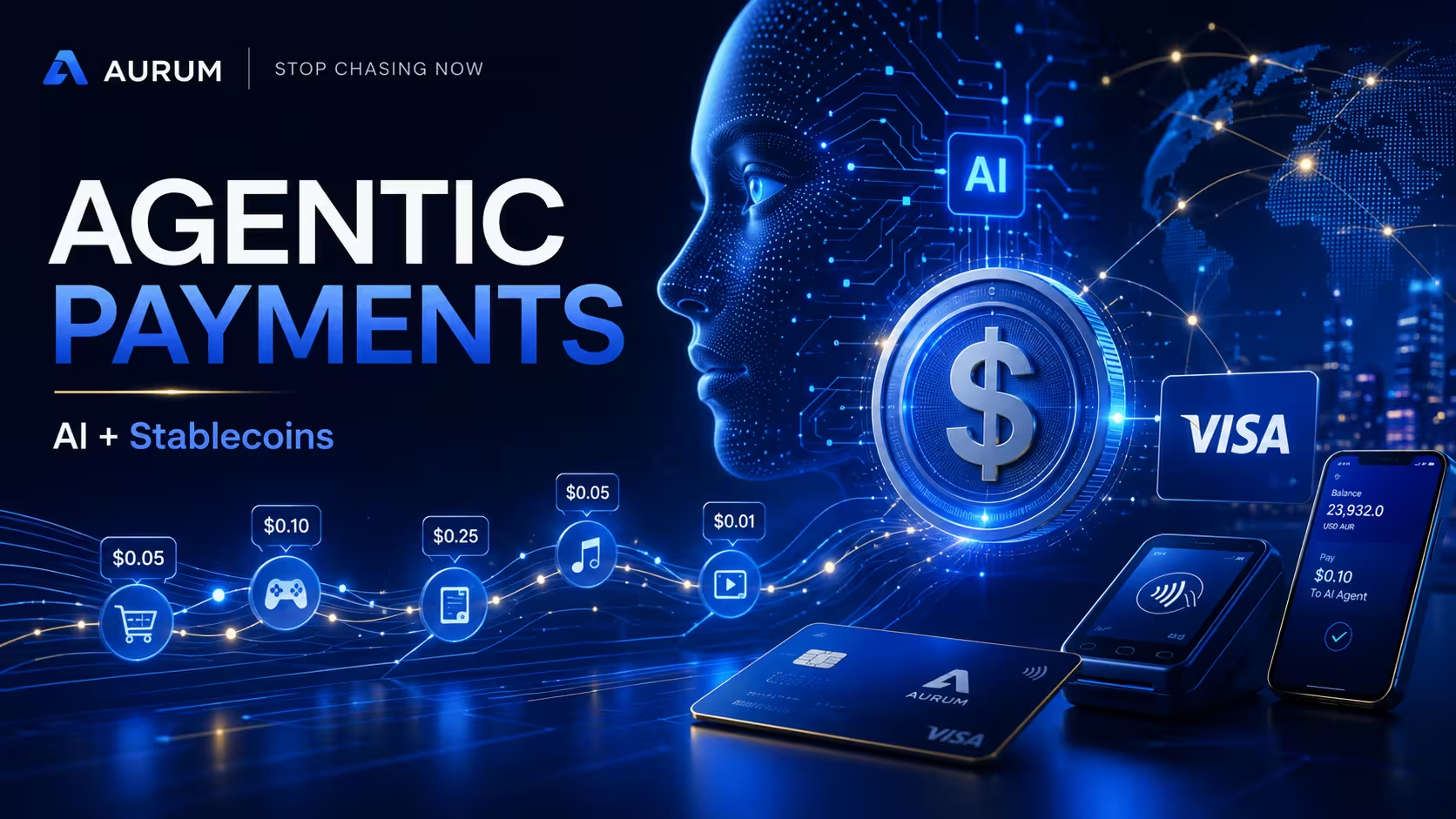
A new report from Visa and blockchain analytics firm Artemis argues that stablecoins could become a critical payment layer for the emerging agentic economy—a world in which AI agents do more than provide information. They perform tasks, interact with other software and initiate transactions on behalf of people and businesses.
In other words, even Visa can see where this is heading:
AI will increasingly need money it can use programmatically.
And stablecoins may be one of the most practical forms of money for the job.
What Is the Agentic Economy?
Most people currently use AI as an assistant.
You ask a question. AI provides an answer. You then decide what to do.
Agentic AI goes further. An AI agent can be given an objective, a budget and a set of rules—and then take approved actions to complete that objective.
For example, an AI agent might:
- Compare flights, select the best option and complete a booking.
- Purchase additional cloud-computing capacity when demand increases.
- Pay for an individual API request or piece of digital information.
- Renew subscriptions according to predetermined limits.
- Coordinate with other AI agents to complete a larger task.
- Manage routine financial or business processes around the clock.
This creates an entirely different kind of economy.
Instead of every transaction being manually initiated by a person, software will increasingly transact with other software.
Visa calls this evolution intelligent, programmable commerce. The company says AI is transforming how transactions begin, while stablecoins are reshaping how value can move behind the scenes.
Why Traditional Payments Do Not Fit Every AI Transaction
Credit and debit cards work extremely well for ordinary consumer purchases.
If an AI assistant books a $600 flight or orders $100 worth of groceries, existing card networks provide merchant acceptance, fraud monitoring, dispute procedures and consumer protections.
But the agentic economy will also produce a second category of activity: micro-commerce.
Micro-commerce can involve extremely small, high-frequency transactions, sometimes worth less than one dollar. An AI agent might pay a few cents for data, computing power, an API call, identity verification or access to a specialized digital service.
A human would never stop to authorize thousands of tiny software payments individually. The amounts may also be too small for conventional payment-processing economics to make sense.
That is where stablecoins become particularly interesting.
Stablecoins can move continuously, globally and programmatically. On efficient blockchain networks, they can potentially settle small transactions at costs that are more compatible with machine-to-machine commerce.
Visa and Artemis therefore see a future in which cards and stablecoins are not necessarily competitors. Cards may continue serving consumer-facing purchases, while stablecoins handle repeated, machine-native transactions between software systems. A single AI workflow could eventually use both.
Stablecoins Are Becoming Financial Infrastructure
This is an important change in perception.
Stablecoins are no longer being discussed solely as instruments for crypto traders. They are increasingly being evaluated as infrastructure for:
- Cross-border settlement
- Digital commerce
- Treasury management
- Business-to-business payments
- Programmable financial services
- AI-agent transactions
- Machine-to-machine micropayments
Visa is actively expanding its own stablecoin settlement capabilities while developing tools intended to identify, authorize and evaluate AI agents participating in commerce. Its announced initiatives include agent scoring, an agentic registry and additional stablecoin settlement support.
Visa is not attempting to pretend the shift is not happening.
It is preparing its network to participate in it.
That should get the attention of anyone who still believes stablecoins, blockchain and agentic finance are passing trends.
What This Has to Do With Aurum Foundation
This development does not mean Visa has endorsed Aurum Foundation, and it should not be presented that way.
What it does validate is the broader technological direction behind Aurum’s vision.
Aurum publicly positions itself as a financial technology ecosystem combining artificial intelligence and blockchain, with an emphasis on digital-asset management, liquidity infrastructure and connections between digital finance and real-world payments.
Its development thesis is larger than simply buying and selling cryptocurrency.
The broader Aurum concept brings several emerging financial layers together:
Artificial intelligence
AI-powered systems can analyze information, identify opportunities and execute predefined financial strategies more efficiently than a person attempting to operate manually around the clock.
Digital assets and stablecoins
Stablecoins provide a programmable representation of value that can move across compatible digital networks.
Liquidity and exchange infrastructure
AI systems need places where assets can be exchanged, managed and deployed.
Payment utility
Digital value becomes more useful when it can move beyond a trading dashboard and connect with ordinary economic activity.
An integrated ecosystem
Rather than treating trading, asset management, payments and blockchain infrastructure as unrelated products, Aurum is attempting to position them as connected parts of a wider AI-finance environment.
Aurum’s trading agents and Visa’s commerce agents are not identical products. One may focus on financial-market activity while the other helps initiate purchases.
However, they depend on a similar underlying idea:
Software is becoming an active economic participant, and it needs programmable financial infrastructure.
That is the larger trend Aurum is building around.
From AI That Advises to AI That Acts
The first generation of consumer AI helped people find information.
The next generation will be expected to act.
That transition requires more than a powerful language model. An agent must be able to:
- Understand its instructions.
- Operate within established permissions.
- Access the correct financial tools.
- Transfer value efficiently.
- Document what it has done.
- Remain accountable to the person or organization using it.
This is why the convergence of AI and blockchain matters.
AI provides intelligence and decision-making capabilities. Blockchain-based assets can provide programmable value and transparent settlement. Stablecoins can reduce the volatility that would make many ordinary transactions impractical.
Together, they create the possibility of a financial system that is increasingly automated, interconnected and available around the clock.
Trust Will Matter as Much as Technology
The technology is developing rapidly, but important questions remain.
Who is responsible when an AI agent makes an incorrect purchase? How should authorization be proven? Can a transaction be reversed? How do merchants distinguish a legitimate agent from a malicious bot? How should spending limits and user consent be enforced?
Visa has acknowledged that trust, liability and dispute resolution remain significant challenges. Existing financial protections were largely built for transactions initiated at human speed—not autonomous software capable of conducting thousands of actions in a short period.
The same principle applies to AI-powered financial platforms.
Automation does not eliminate risk. An AI trading system can still experience losses. Stablecoins can carry issuer, regulatory, network and liquidity risks. Smart contracts and digital wallets require appropriate security practices.
The strongest platforms will not simply advertise AI. They will demonstrate how user control, transparency, risk management and security are incorporated into the system.
Aurum Is Not Waiting for the Future to Arrive
Many financial companies are only beginning to add the language of AI, stablecoins and programmable commerce to their roadmaps.
Aurum’s entire positioning has been built around their convergence.
That does not guarantee the success of Aurum or any individual product. It does, however, show that the market Aurum is pursuing is no longer an isolated idea at the edge of finance.
Major payment networks are preparing for AI agents.
Stablecoins are being evaluated as settlement infrastructure.
Financial activity is becoming increasingly programmable.
The separation between traditional finance, digital assets and artificial intelligence is beginning to disappear.
Visa’s latest message is not that cards are about to vanish or that stablecoins will replace every existing payment system. Its message is more nuanced—and arguably more significant:
The future will be hybrid.
AI agents may move between traditional payment networks, stablecoins, blockchain infrastructure and other financial tools depending on the task they need to complete.
That type of interconnected environment is precisely why an ecosystem approach matters.
The Bigger Picture
The real story is not simply that Visa published another report about cryptocurrency.
The story is that one of the most established payment companies in the world now expects AI agents to become genuine participants in commerce—and sees stablecoins helping those agents transact.
The future of finance may not revolve around people manually clicking every button, placing every trade or approving every minor payment.
It may involve people establishing goals, permissions and risk limits while intelligent systems perform more of the underlying work.
Aurum Foundation is positioning itself for that transition by combining AI-powered financial tools, digital assets, liquidity infrastructure and payment utility inside one evolving ecosystem.
There is still much to build, test and prove. Regulation, security, adoption and performance all matter. Responsible users should evaluate the platform carefully and never confuse technological potential with guaranteed financial results.
But the direction is becoming increasingly difficult to dismiss.
AI will not only help people understand money. It will increasingly interact with money.
And as Visa now recognizes, stablecoins may be one of the primary ways intelligent machines transact in the economy ahead.
That future is no longer science fiction.
It is being built now.